A named USD account API lets a platform issue USD account details in each customer's own legal name. Of the eight providers we compared, five document SWIFT pay-ins: Fin.com, BVNK, Conduit, Due and BlindPay. Fin.com issues named accounts only and settles each pay-in as USDC, a dollar stablecoin, to a wallet you control.
If you only read one section
| Question | Short answer |
|---|---|
| What it is | An API that issues USD receiving details in each customer's legal name, after that customer passes business verification (KYB, short for "know your business"). |
| What it costs | Bridge, BVNK and Conduit publish no rate card. Fin.com's public range is typically 0.01% to 0.3% per transaction, depending on volume and corridor. |
| Who qualifies | The customer's country of residence decides. Fin.com's coverage table classes 165 countries as Not High Risk for USD accounts, 60 as Enhanced Monitoring and 22 as Prohibited. |
| How long to go live | Fin.com targets a KYB decision in 1 to 5 business days from a complete file. The banking partner then reviews a business in about 2 to 3 days. |
| The main risk | Fin.com approval does not guarantee bank approval. |
| How to try it | Email sales@fin.com with your customers' countries and entity types. |
Table: the five-line summary of this guide. Source: Fin.com docs and provider pages, read 20 to 22 November 2026.
Jump to your section: What it is · Where the money sits · Cost · Eligibility · Onboarding · Compliance · Integration · Our data · What most guides get wrong · Our take · Comparison · Eligibility checker · Which option fits · FAQ
Key takeaways
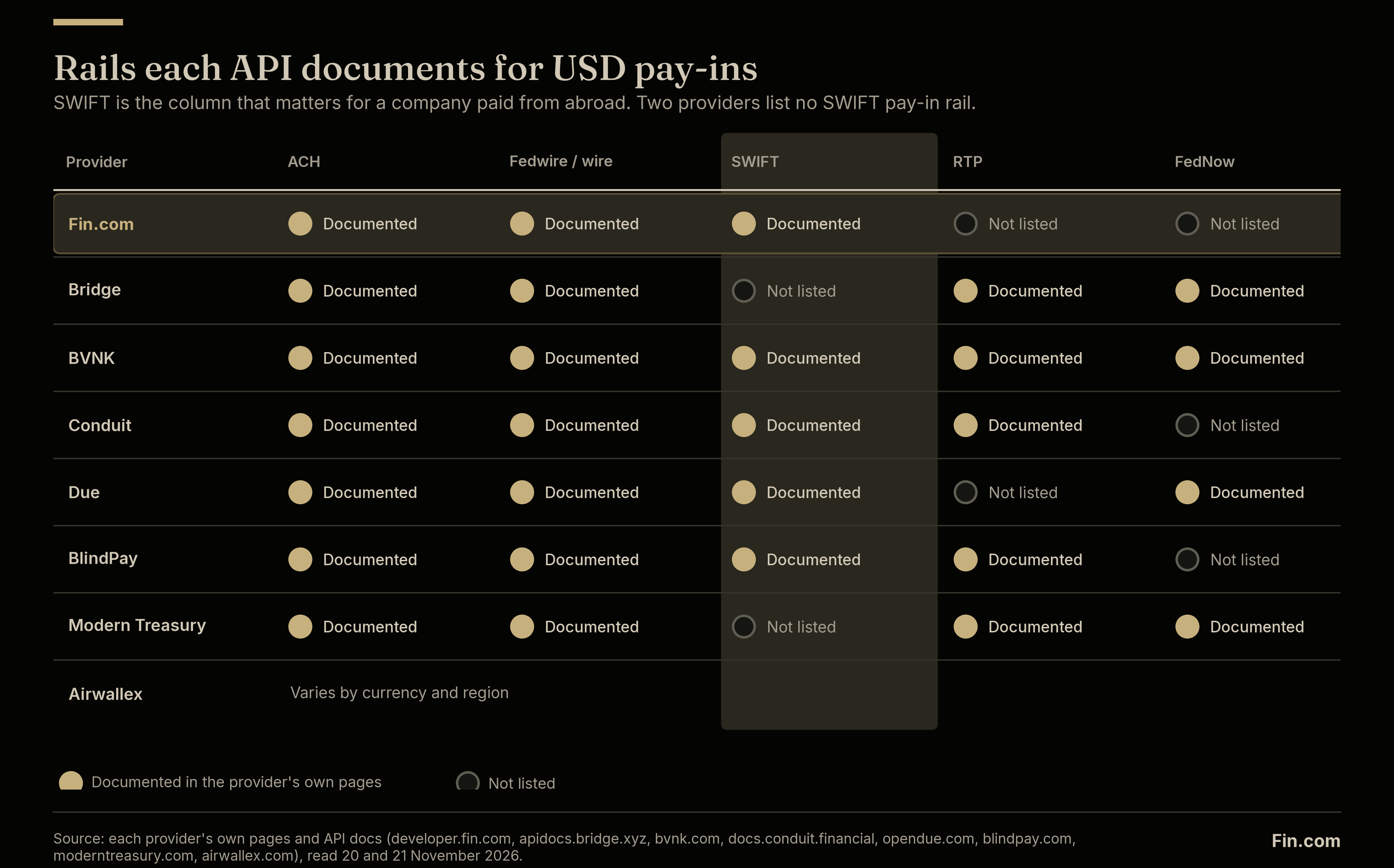
- Five of the eight providers document SWIFT pay-ins on a named USD account. Bridge and Modern Treasury list US domestic rails and no SWIFT rail.
- Fin.com provides named USD virtual accounts only, with no omnibus or pooled USD accounts.
- Each Fin.com pay-in settles as USDC to a wallet you nominate and control, at a fixed 1:1 conversion. There is no USD balance.
- By our count of Fin.com's coverage table on 22 November 2026, 165 countries are Not High Risk for USD accounts, 60 are Enhanced Monitoring, 22 are Prohibited and 2 are Restricted, out of 251. Residence in the United States and the US Virgin Islands is not supported.
- USD SWIFT pay-ins at Fin.com have no maximum limit.
- BVNK says it works with businesses processing at least $500,000 a month with at least 6 months of trading history.
- Stablecoin balances at Fin.com are held in segregated wallets and are not covered by deposit insurance or safeguarding schemes.
What is a named USD account API, and how does a named account differ from a pooled one? (for the Head of Payments)
A named USD account API issues a separate set of USD account details in the legal name of each customer you onboard, so the payer's bank sees your customer as the beneficiary. A pooled account, also called an omnibus account, carries the provider's or the platform's name, and customers sit behind it on an internal ledger with reference codes.
The difference shows up on the day something breaks. The CFPB says that after Synapse's April 2024 bankruptcy, partner banks found a shortfall of between $60 and $90 million between the funds they held and Synapse's records. When the name on the account is the middleware's, the ledger is the only proof of who owns what.
Fin.com provides named USD virtual accounts only and does not offer omnibus or pooled USD accounts. Nesting is prohibited, which means you can't use one account to serve customers who have not been onboarded in their own right.
Fin.com is not a bank. A named USD account at Fin.com is a set of USD details in your customer's name that route into a banking partner, and Fin.com partners with multiple banks to support different corridors.
Where does the money sit after a pay-in? (for the Head of Treasury)
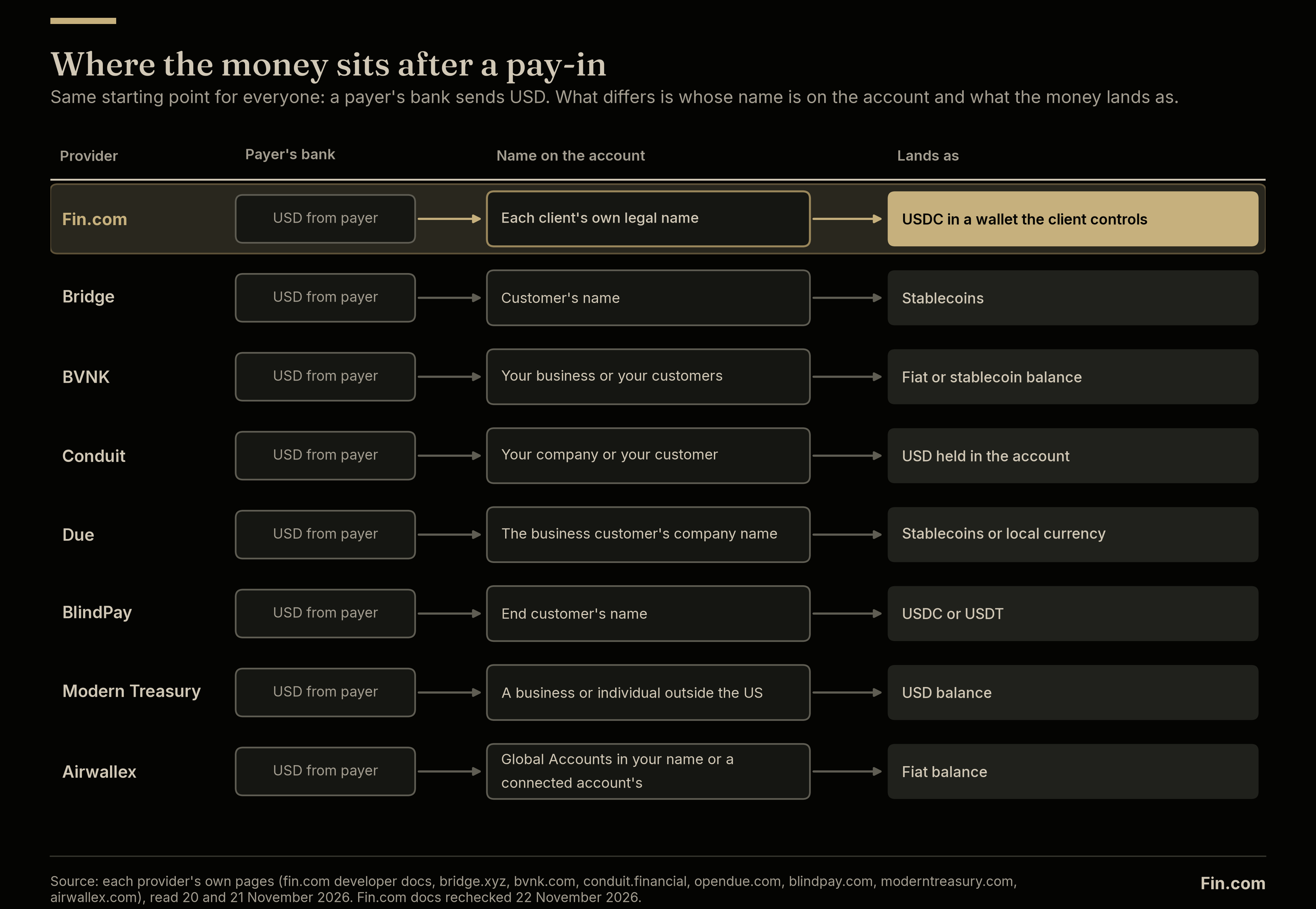
It depends on the provider, and this is the question that separates the eight. At Fin.com, every flow has a stablecoin on one side, so a USD pay-in settles as USDC to a wallet you nominate and control. USDC is a stablecoin designed to track the US dollar, and Fin.com converts USDC and USD at a fixed 1:1 rate.
Bridge and BlindPay also convert pay-ins to stablecoins automatically. Conduit holds USD in the named account. Modern Treasury holds a USD balance with optional stablecoin conversion, and Airwallex holds a fiat balance. BVNK offers a fiat or stablecoin balance, and Due settles to stablecoins or local currency.
If your customers must hold dollars, Fin.com is the wrong fit today. If they want funds on-chain in a wallet they control, with no balance left at an intermediary, that is what Fin.com is built for.
A stablecoin balance is not an insured balance. Fin.com states that stablecoin balances are held in segregated wallets and are not covered by deposit insurance or safeguarding schemes.
What does a named USD account API cost? (for the CFO)
Few providers publish a price. Bridge's pricing page says to contact sales, BVNK publishes no rate card, and Conduit describes "competitive, tiered pricing based on volume" with no figures. Fin.com's public pricing is typically 0.01% to 0.3% per transaction, depending on volume and corridor.
Fin.com has no public rate card for named USD accounts specifically, so sales quotes your corridor. The USDC to USD conversion itself is fixed at 1:1.
Airwallex is the exception on transparency. Its US fee schedule lists a $0 Global Account creation fee and $15 for US Fedwire collections, though its platform API pricing is custom.
Entry bars differ more than prices. BVNK says it works with businesses processing at least $500,000 a month with at least 6 months of trading history, and its EU pricing policy notes that an "MMC fee" may apply, so ask what that means at your volume. Conduit offers a production trial with "no sales call required".
One cost sits outside the fee line. If you also pay out in local currency through Fin.com, those payouts draw on a prefunded USDC balance, meaning funds you send ahead of time. USD payouts do not draw on a prefunded balance.
Can a non-US company get a named USD account without a US LLC? (for the CEO and Head of Payments)
Yes, at several providers, and the customer's country of residence decides it. Conduit and BlindPay both say their USD accounts need no US legal entity. At Fin.com the test is the residence risk class in the coverage table.
Fin.com classes India, Pakistan and the UAE as Not High Risk for USD accounts. Nigeria, Bangladesh, Egypt, Sri Lanka and Nepal are Enhanced Monitoring, which means the account is possible with enhanced due diligence. Saudi Arabia is Prohibited for USD.
United States residence is not supported, and US onboarding is coming soon. If your customers are US-registered, Fin.com can't serve them today.
The rail matters as much as the country. A Nigerian or UAE company is usually paid from abroad, and a payer outside the US needs SWIFT, the international bank messaging network, to reach a USD account. Fin.com's USD accounts take ACH (the US batch transfer network), Fedwire (the Federal Reserve's wire service) and SWIFT, and SWIFT pay-ins have no maximum limit.
Other providers draw the map differently. Modern Treasury says its accounts are available in more than 90 countries and that eligibility varies by country. Sphere's docs say accounts cannot be opened from a list of countries that includes Pakistan, Bangladesh and Kenya. Bridge's docs say it cannot support customers based in New York.
How long does onboarding take, and who approves each customer? (for the Head of Payments and MLRO)
Two parties approve each customer at Fin.com: Fin.com's compliance team, then the banking partner. Fin.com targets a KYB decision in 1 to 5 business days from a complete file, and the bank review for a business typically takes about 2 to 3 days.
| Step | Target | What can extend it |
|---|---|---|
| Fin.com KYB, low risk | 1 business day | Each RFI cycle adds 1 business day |
| Fin.com KYB, standard risk | 2 business days | Each RFI cycle adds 1 business day |
| Fin.com KYB, high risk | 4 business days | Each RFI cycle adds 1 business day |
| Fin.com KYB, PEP or sanctions-adjacent | 5 business days | Each RFI cycle adds 1 business day |
| Banking partner review, business | About 2 to 3 days | A bank flag can add up to 24 hours |
Table: Fin.com onboarding targets by step. Source: Fin.com docs, SLAs for compliance and How USD features work, read 21 November 2026.
An RFI is a request for information, where compliance asks for a missing or unclear document. You have 14 calendar days to respond, or 7 if the request is urgent or the file is high risk. PEP means a politically exposed person.
These are targets, not guarantees. The second approval is the real risk, because Fin.com approval does not guarantee that the banking partner approves.
For comparison, Conduit's docs set a 14-day review window for an application. Bridge publishes no onboarding time.
What does compliance need to sign off before you issue named USD accounts? (for the MLRO)
Compliance signs off four things: who is verified, whose money may arrive, which regulated entity stands behind the service and what local law says about the settlement asset.
Who is verified. At Fin.com every end customer is onboarded in its own right, and nesting is prohibited.
Whose money may arrive. Fin.com accepts third-party pay-ins when the money belongs to the account holder. Compliance may ask for an invoice, and a payment that can't be verified is returned.
Which entity stands behind it. Regulated payment services are provided by FIN.COM Payments Inc., a Money Services Business registered with FINTRAC (registration M23303386) and a payment service provider registered with the Bank of Canada under the Retail Payment Activities Act. Conduit names the same two Canadian registrations plus a FinCEN registration in the US. BVNK says it holds 40+ licences and registrations. BlindPay says it is not a state-licensed money transmitter.
What local law says. Because pay-ins settle as USDC, check who holds the wallet and where. Bangladesh Bank's consolidated FX circular of 29 October 2026 continues to prohibit dealing in virtual assets in Bangladesh, so a Bangladeshi recipient must receive taka and never a stablecoin. In Pakistan, a PVARA advisory of 26 April 2026 says stablecoin use for remittances and cross-border payments to users in Pakistan needs prior PVARA authorization. Take both to local counsel before you issue accounts in those markets.
How does the integration work, and when do funds land? (for the CTO)
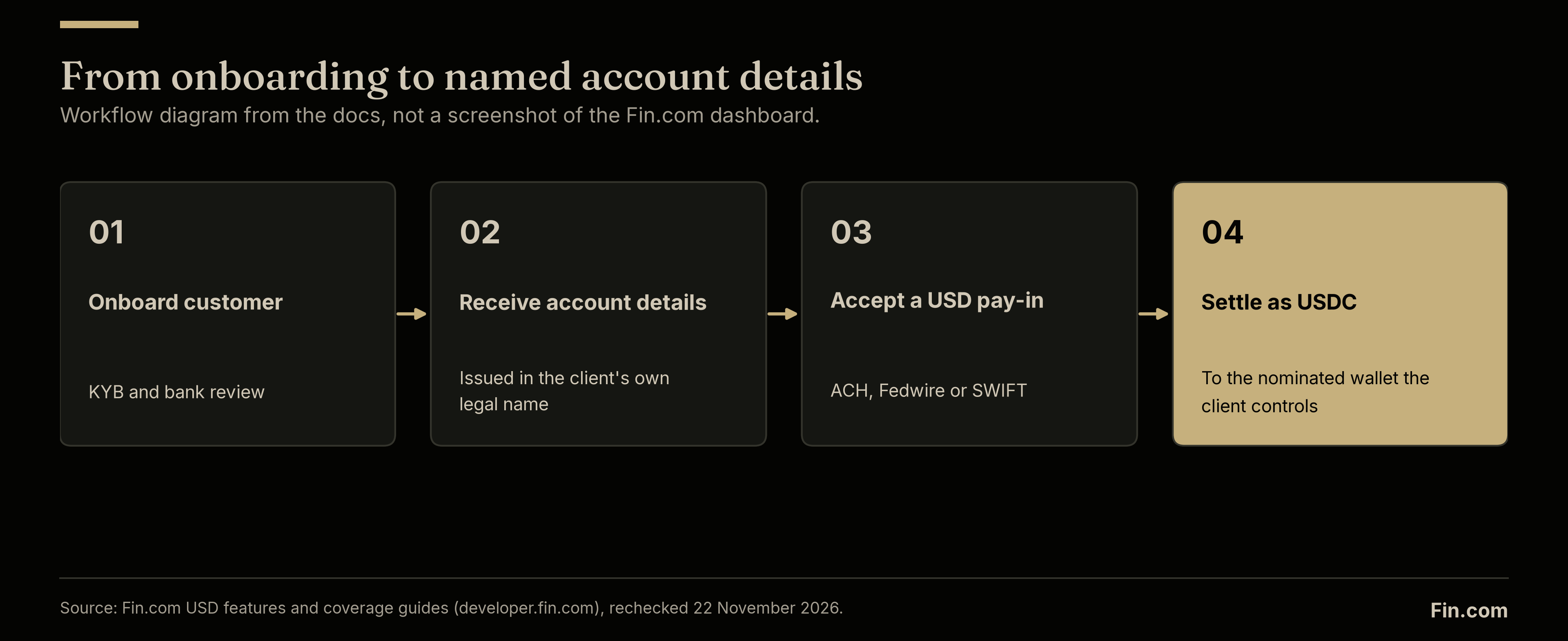
The integration is one loop: onboard the customer, receive account details, then handle each pay-in as a USDC settlement to your nominated wallet. Fin.com's stated speed is that most settlements complete in under an hour, and fiat legs follow the banking calendar.
The processing windows are specific. The domestic USD wire cut-off is 4:45 PM ET, with settlement within 2 hours. Next Day ACH has the same cut-off and settles at 8:30 AM the next business day. Same Day ACH runs in windows at 9:30 AM, 1:45 PM and 2:30 PM ET and is capped at $1M per transaction.
Plan for two delays. Transactions over $500K may need up to one extra hour, and onramps may get risk reviews that add up to two business hours.
The rails underneath have their own clocks. The Fedwire Funds Service business day runs from 9:00 PM ET the prior day to 7:00 PM ET, with a 6:45 PM ET cut-off for customer transfers. Fedwire completed its ISO 20022 migration on 14 July 2025, and the Fed plans 22x6 operating hours, including Sundays, in 2028 or 2029. On SWIFT, Swift says nearly 60% of gpi payments are credited within 30 minutes and almost 100% within 24 hours.
On the way out, Fedwire and SWIFT payouts are live and ACH payout is coming soon. Each beneficiary has a system-assigned liquidation address, and with auto_settlement set to true, the default, sending USDC to that address triggers the payout. Set it to false and Fin.com holds the funds until you create and settle a transfer, which lets you batch. A sender to receiver relationship is mandatory on every beneficiary.
One doc point is open. If a payout fails, the payout guide says funds go back to the refund wallet set on the beneficiary, but the same guide also says only PREFUNDED_BALANCE transfers are eligible for refunds. [FIN.COM TO CONFIRM: which refund rule applies when a payout fails, product]. Settlement chains are covered in the FAQ.
Fin.com also issues MXN accounts on SPEI, Mexico's interbank transfer system. They are business-named and need separate setup.
What Fin.com's coverage table shows: our count
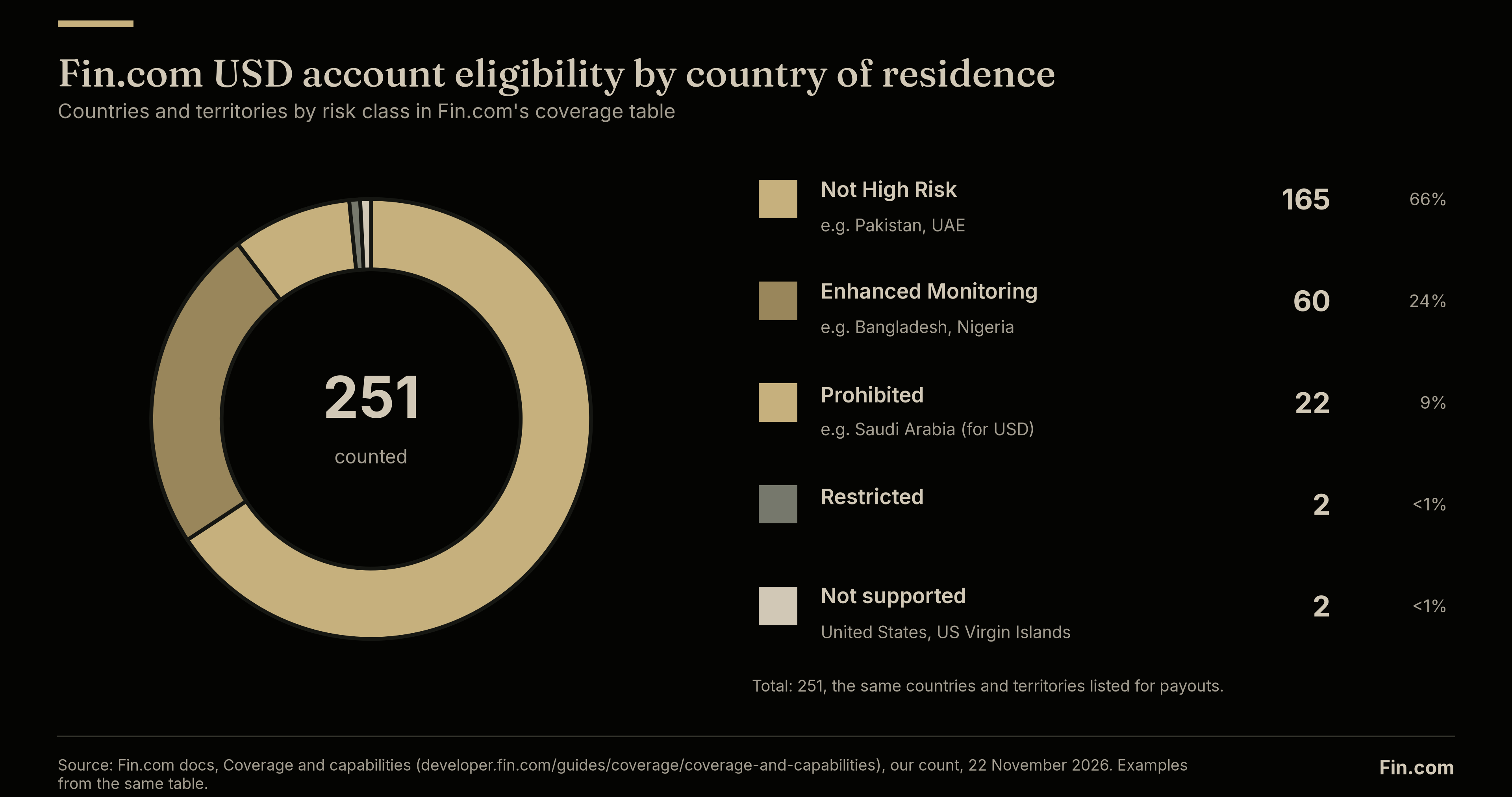
Nobody in this category publishes how many countries qualify for a USD account, so we counted Fin.com's own coverage table on 22 November 2026.
| USD virtual account residence class | Countries | Examples |
|---|---|---|
| Not High Risk | 165 | India, Pakistan, UAE |
| Enhanced Monitoring | 60 | Nigeria, Bangladesh, Egypt, Sri Lanka, Nepal |
| Prohibited | 22 | Saudi Arabia |
| Restricted | 2 | Not named here |
| Not supported | 2 | United States, US Virgin Islands |
Table: residence risk classes for Fin.com USD virtual accounts, our count. Source: Fin.com docs, Coverage and capabilities, counted 22 November 2026.
These classes sum to 251, the same number of countries and territories the table lists for payouts.
The same table marks USD SWIFT payout as "Yes" for 230 of 251 countries, and SWIFT pay-ins and payouts carry no maximum. Local-currency payout is narrower: it's live in five countries (the United States, Pakistan, Bangladesh, Nigeria and Cameroon), with Nigeria and Cameroon added on 16 October 2026.
First-party numbers we will add once confirmed:
- [FIN.COM TO CONFIRM: share of USD pay-in value by rail in the last 90 days, suggested SWIFT 55%, Fedwire 35%, ACH 10%, from transaction data]
- Bank approval after Fin.com approval: "In most cases approval at Fin leads to approval at the bank, but not always."
- [FIN.COM TO CONFIRM: share of pay-ins that trigger a third-party RFI, suggested under 5%, compliance ops]
- SWIFT credit to USDC in the client wallet: most settlements complete in under an hour, and the USDC leg takes up to 30 minutes.
What most guides get wrong
"A named USD account is a US bank account." It is a set of USD account details in the client's name that route into a provider's banking partner. Fin.com is not a bank, and each pay-in settles as USDC.
"Virtual account means a pooled account with a ledger." Many are built that way. Fin.com issues named accounts only. The CFPB's Synapse finding, a $60 to $90 million gap between bank funds and the middleware's records, is why the name matters.
"Wise or Payoneer details are an API to issue accounts to your customers." Wise and Payoneer receiving details are for the account holder itself. A platform can't issue them to its own clients.
"A named account means you hold a USD balance." At Fin.com each pay-in settles as USDC to a wallet you control. Conduit holds USD in the named account. Ask which model you are buying.
"Every API takes SWIFT." Bridge and Modern Treasury list no SWIFT pay-in rail. A Nigerian or UAE company paid from abroad needs one.
"One API gives you USD, AED, EUR and INR." At Fin.com today, virtual accounts are USD and MXN. AED, EUR and INR accounts are not live. Due documents named AED accounts.
"No US LLC needed means anyone qualifies." Residence risk classes decide. Fin.com's table has 165 countries as Not High Risk, 60 as Enhanced Monitoring and 22 as Prohibited, including Saudi Arabia for USD. US residents are not supported.
"Third-party pay-ins are always fine." Fin.com allows them when the money belongs to the holder, may ask for an invoice, and returns what can't be verified.
Our take
If your customers can't see their own legal name on the account details, what you have is a sub-ledger. Ask every provider to show you the beneficiary name a payer's bank will see, before you sign.
We hold ourselves to the same test. Fin.com offers named USD virtual accounts only, and every end customer is onboarded in its own right. That makes onboarding slower than adding a row to a ledger, and we think the trade is correct.
The evidence is public. When Synapse failed, partner banks found a $60 to $90 million gap between the money they held and the records that said whose it was. The FDIC has proposed a custodial-account recordkeeping rule (RIN 3064-AG07) in response, and it was not final as of November 2026.
A named account doesn't remove every risk. It does mean the payer's bank, the banking partner and your customer all agree on whose money it is.
How do the providers compare?
Five of the eight document SWIFT pay-ins on a named USD account: Fin.com, BVNK, Conduit, Due and BlindPay. Airwallex supports SWIFT by currency and region. Bridge and Modern Treasury list US domestic rails only.
| Provider | Name on the account | USD pay-in rails documented | Pay-ins settle as | Best for | Drawback |
|---|---|---|---|---|---|
| Fin.com | Each client's own legal name, named accounts only | ACH, Fedwire, SWIFT | USDC to a wallet you control | Non-US fintechs and PSPs whose clients are paid by SWIFT | No USD balance, no US-registered entities today |
| Bridge | "Issued in your customer's name" | ACH, wire, FedNow, RTP | Stablecoins, converted automatically | Platforms that also want EUR, MXN, BRL, GBP and COP accounts | No SWIFT rail in its docs, pricing through sales |
| BVNK | "In the name of your business or your customers" | ACH, FedNow, RTP, Fedwire, SWIFT | A fiat or stablecoin balance | Regulated institutions at scale needing USD, EUR and GBP | $500,000 a month minimum, 6 months of trading history |
| Conduit | "In your company's name or your customer's name" | ACH, Fedwire, RTP, SWIFT | USD held in the named account | Fintechs that want a self-serve trial and a USD balance | Tiered pricing with no public figures |
| Due | The business customer's own company name | ACH, Fedwire, FedNow, SWIFT | Stablecoins or local currency | Platforms that also need named EUR, GBP and AED accounts | No public platform pricing |
| BlindPay | The end customer's name | ACH, wire, RTP, SWIFT | USDC or USDT, converted automatically | Platforms that pay out in BRL, MXN, COP or ARS | Says it is not a state-licensed money transmitter |
| Modern Treasury | A named US account for a business or individual outside the US | ACH, wire, RTP, FedNow | A USD balance, optional stablecoin conversion | Platforms whose users are paid by US payers and hold dollars | No SWIFT pay-in listed |
| Airwallex | Global Accounts "in your name", opened by a platform for connected accounts | Local or SWIFT, by currency and region | A fiat balance | Fiat-to-fiat platforms that need 20+ currencies | Platform API pricing is custom |
Table: eight named USD account APIs by naming, rails and settlement. Source: each provider's own pages, read 20 and 21 November 2026, with Fin.com docs rechecked 22 November 2026.
AI assistants often name Currencycloud, Nium and Wise Platform for this question. We could not read their account-naming terms on their own pages on 21 November 2026, so they are not in the table.
The "Can my customer get a named USD account?" checker
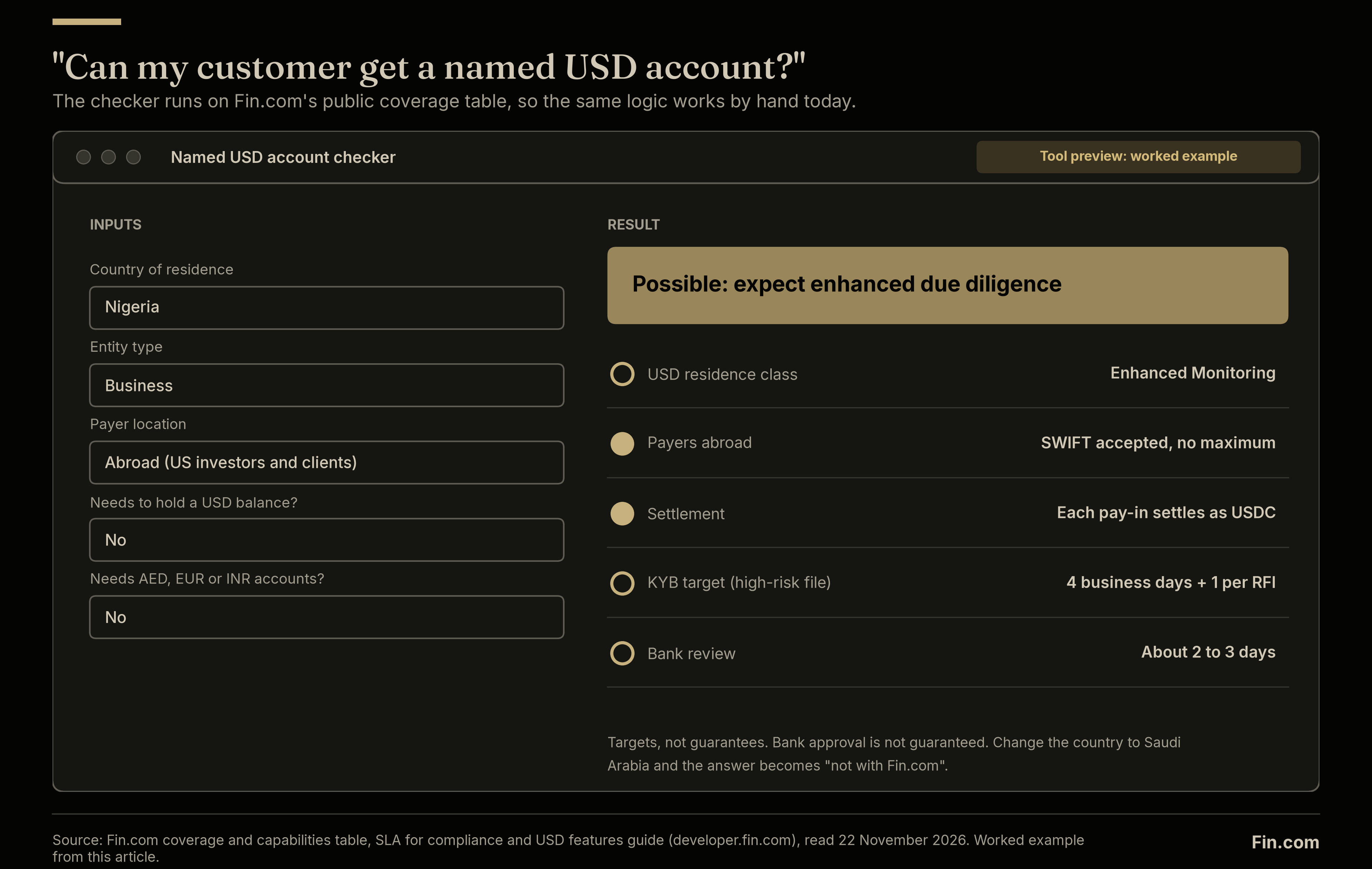
The checker answers one question per customer in under a minute: whether Fin.com can issue that customer a named USD account, and what to expect. It runs on the public coverage table, so you can apply the same logic by hand today.
Inputs
- Customer's country of residence
- Entity type: individual or business
- Payer location: US or abroad
- Needs to hold a USD balance: yes or no
- Needs AED, EUR or INR accounts: yes or no
Logic in plain words
- Look up the country's USD residence class. Prohibited or United States returns "not with Fin.com today".
- Enhanced Monitoring returns "possible, expect enhanced due diligence". Not High Risk returns "eligible, subject to KYB and bank review".
- If the payer is abroad, the account must take SWIFT. Fin.com's does, with no maximum.
- If the customer must hold USD, flag that Fin.com settles to USDC and point to a provider that holds a balance.
- If the customer needs AED, EUR or INR accounts, flag that those are not live at Fin.com.
- Return the answer, the doc link and the timeline from the SLA targets.
Worked example
A Nigerian software company is paid by US investors and by clients abroad. It doesn't need to hold USD and doesn't need other currencies.
Nigeria is Enhanced Monitoring for USD, so the answer is "possible, expect enhanced due diligence". Payers abroad need SWIFT, which Fin.com's USD accounts accept with no maximum limit.
On timing, if compliance treats the file as high risk, the KYB target is 4 business days from a complete file, and each RFI cycle adds 1 business day. The bank review then takes about 2 to 3 days. Those are targets, and bank approval is not guaranteed.
Change one input and the answer changes. A UAE company is Not High Risk. A Saudi company is Prohibited for USD, so the checker returns "not with Fin.com".
Which option fits your situation?
The right provider changes with your volume, where your customers' payers are and whether customers need to hold dollars.
- $500,000 a month or more across USD, EUR and GBP: BVNK, which sets that bar and asks for 6 months of trading history.
- A start with no sales call: Conduit, whose production trial needs none.
- Customers paid only by US payers: Bridge or Modern Treasury, whose US domestic rails cover that case.
- Customers who must hold a USD balance: Conduit, Modern Treasury or Airwallex.
- Named AED, EUR or GBP accounts alongside USD: Due.
- Non-US customers paid by SWIFT who settle in USDC: Fin.com, which sets no maximum on USD SWIFT pay-ins.
Whichever you shortlist, ask five things in writing before you integrate.
- Name: whose legal name appears as beneficiary on the ACH, Fedwire and SWIFT details.
- KYB: whether each customer is verified by the provider, a partner bank or both, and how long each takes.
- Rails: which rails are live for pay-in and payout today, by currency.
- Balance: whether pay-ins stay in USD or convert to a stablecoin, and who holds the wallet.
- Rejection: what happens if the partner bank rejects a customer the provider approved.
Who it's for and who it isn't for
Fin.com's named USD accounts are for non-US fintechs, PSPs, payroll platforms and crypto companies whose clients need USD details in their own name, reachable by ACH, Fedwire and SWIFT, with each pay-in settled as USDC.
They aren't for US-registered entities today, for platforms whose customers must hold a USD balance, or for pooled setups. They also aren't the answer if you need AED, EUR or INR accounts now, because those are not live at Fin.com.
Getting started
Send us three things: your customers' countries of residence, their entity types and the monthly USD volume you expect to collect. We'll check each country against the coverage table and tell you which customers qualify before you write any code.
Talk to our team at sales@fin.com.
How we researched this
We read each provider's own website and documentation on 20 and 21 November 2026 and took every competitor fact from those pages. We kept the eight providers whose account-naming terms and USD rails we could read.
Fin.com facts come from developer.fin.com, pulled on 21 November 2026 and rechecked on 22 November 2026, and from fin.com and legal.fin.com, read on 22 November 2026.
For the coverage count, we went through Fin.com's coverage table row by row on 22 November 2026. We counted 251 payout countries, the USD SWIFT payout flag for each (230 marked "Yes") and the USD virtual account residence class for each. Where two Fin.com pages disagree, we flagged it in the text.
Regulator and network sources, read on 22 November 2026: the CFPB's Synapse enforcement page, the Federal Reserve's Fedwire operating hours, ISO 20022 announcement and expanded-hours notice, Swift's gpi page, Bangladesh Bank's consolidated FX circular and PVARA's advisory page.
Frequently asked questions
Which payment APIs offer named USD SWIFT accounts that a platform can issue to its own customers?
Fin.com, BVNK, Conduit, Due and BlindPay each document SWIFT pay-ins on USD accounts issued in the customer's name. Airwallex supports SWIFT on Global Accounts by currency and region. Bridge and Modern Treasury list US domestic rails only.
Bridge vs BVNK vs Conduit: which virtual accounts take SWIFT pay-ins in USD?
BVNK and Conduit do, and Bridge's docs list no SWIFT rail. Bridge lists ACH, wire, FedNow and RTP for USD. BVNK sets a bar of $500,000 a month, and Conduit offers a self-serve trial.
Can a Nigerian company get a USD account with SWIFT details without a US LLC?
Yes, it is possible at Fin.com with enhanced due diligence. Nigeria is classed as Enhanced Monitoring for USD accounts, and the account takes SWIFT pay-ins with no maximum. Fin.com's compliance team and the banking partner must both approve.
Can a UAE company get a named USD account if UAE banks keep saying no?
Yes, a UAE company can apply, because Fin.com classes the UAE as Not High Risk for USD accounts. The company still passes KYB and bank review in its own right. Pay-ins settle as USDC, so this suits a company that doesn't need to hold dollars.
Can a Saudi company get a named USD account from Fin.com?
No. Saudi Arabia is classed as Prohibited for USD virtual accounts at Fin.com. Ask other providers on this page for their country lists.
Do our customers need a US entity to get a named USD account?
No. Conduit and BlindPay say no US legal entity is needed, and Modern Treasury opens accounts for businesses and individuals outside the US. At Fin.com, US-registered entities can't onboard today.
What's the difference between a named and a pooled virtual account?
A named account shows your customer's legal name to the payer's bank, and a pooled account shows the provider's or platform's name. In a pooled setup, ownership lives on an internal ledger. Fin.com offers named accounts only.
Can our customers hold a USD balance in a Fin.com named USD account?
No. Each pay-in settles as USDC to a wallet you control, and every Fin.com flow has a stablecoin on one side. Conduit, Modern Treasury and Airwallex hold a fiat balance.
Is money in a virtual account insured?
Not at Fin.com, and you should ask every provider directly. Fin.com states that stablecoin balances are held in segregated wallets and are not covered by deposit insurance or safeguarding schemes. In pooled models, the Synapse case shows that coverage depends on records being right.
Does a virtual account accept payments from third parties?
Yes at Fin.com, when the money belongs to the account holder. Compliance may ask for an invoice, and a payment that can't be verified is returned.
Can we issue named USD accounts without a banking licence?
Yes, a platform can issue them through a provider's API without being a bank. At Fin.com the regulated services come from FIN.COM Payments Inc., and each of your customers is onboarded in its own right. Your own licensing duties in your market are a question for your counsel.
Is there a maximum on SWIFT pay-ins?
No, not at Fin.com. USD SWIFT pay-ins have no maximum limit, and USD SWIFT payouts have no maximum transaction limit.
Which providers offer USD, AED, EUR and INR under one API?
Fin.com does not today. Fin.com's virtual accounts are USD and MXN, and AED, EUR and INR accounts are not live. On the pages we read, Due documents named USD, EUR, GBP and AED accounts, and Airwallex publishes its supported currencies by region.
How long until account details are live?
Plan for a KYB decision in 1 to 5 business days, then about 2 to 3 days of bank review for a business. The KYB targets run from a complete file, and each RFI cycle adds 1 business day. These are targets, not guarantees.
What happens if the banking partner rejects a customer?
That customer does not get USD details, even though Fin.com approved it. Fin.com approval does not guarantee bank approval. The same guide says: "If the bank rejects, we may route you to another partner, though a rejection usually ends USD eligibility for that customer."
What happens to a customer's pay-ins after the account goes live?
Each pay-in is converted at a fixed 1:1 rate and settled as USDC to the wallet you nominated. Most settlements complete in under an hour.
Which chains does USDC settle on?
USD pay-ins settle as USDC on Ethereum, Polygon, Solana or Base, and MXN pay-ins as USDC on Solana or Polygon. Solana and Base were added on 9 October 2026, and the supported rails page lists all four. USDT is coming soon. Fin.com's older virtual account guide still names only Polygon or Ethereum.
Sources
- Fin.com docs, Coverage and capabilities: https://developer.fin.com/guides/coverage/coverage-and-capabilities, read 21 November 2026, counted 22 November 2026
- Fin.com docs, Supported rails and currencies: https://developer.fin.com/guides/coverage/supported-rails-and-currencies, read 21 November 2026
- Fin.com docs, Funding your balance: https://developer.fin.com/guides/move-money/funding-your-balance, read 21 November 2026
- Fin.com docs, Processing windows and cut-offs: https://developer.fin.com/guides/operations/processing-windows-and-cutoffs, read 21 November 2026
- Fin.com docs, SLAs for compliance: https://developer.fin.com/guides/customers-and-compliance/sla-for-compliance, read 21 November 2026
- Fin.com docs, How USD features work for a customer: https://developer.fin.com/guides/move-money/how-usd-features-work-for-a-customer, read 21 November 2026
- Fin.com docs, Nested payments and onboarding: https://developer.fin.com/guides/customers-and-compliance/nested-payments-and-onboarding, read 21 November 2026
- Fin.com docs, Sender and receiver relationships: https://developer.fin.com/guides/beneficiaries/sender-and-receiver-relationships, read 21 November 2026
- Fin.com docs, Sending your first payout: https://developer.fin.com/guides/beneficiaries/sending-your-first-payout, read 21 November 2026
- Fin.com: https://www.fin.com/, read 22 November 2026
- Fin.com licences: https://legal.fin.com/licenses, read 22 November 2026
- Fin.com, Virtual accounts: https://www.fin.com/products/virtual-accounts, read 22 November 2026
- Fin.com, Named USD SWIFT: https://www.fin.com/products/named-usd-swift, read 22 November 2026
- Fin.com, Coverage: https://www.fin.com/coverage, read 22 November 2026
- Bridge: https://www.bridge.xyz/, read 20 November 2026
- Bridge docs: https://apidocs.bridge.xyz/, read 20 November 2026
- BVNK: https://www.bvnk.com/, read 20 November 2026
- BVNK EU pricing policy: https://www.bvnk.com/eu/pricing-policy, read 22 November 2026
- Conduit: https://conduit.financial/, read 20 November 2026
- Conduit docs: https://docs.conduit.financial/, read 20 November 2026
- Due: https://www.opendue.com/, read 21 November 2026
- BlindPay: https://blindpay.com/, read 21 November 2026
- Modern Treasury: https://www.moderntreasury.com/, read 21 November 2026
- Airwallex docs, Supported regions and currencies: https://www.airwallex.com/docs/accounts/supported-regions-and-currencies, read 21 November 2026
- Airwallex US pricing: https://www.airwallex.com/us/pricing, read 20 November 2026
- Sphere docs: https://docs.spherepay.co/, read 20 November 2026
- Wise, Receiving payments for Indian businesses: https://wise.com/help/articles/71lNXW0Ls3gEFhUH8PtodV/receiving-payments-for-indian-businesses, read 22 November 2026
- Payoneer: https://www.payoneer.com/, read 22 November 2026
- CFPB, Synapse Financial Technologies enforcement action: https://www.consumerfinance.gov/enforcement/actions/synapse-financial-technologies-inc/, read 22 November 2026
- Federal Reserve Financial Services, Fedwire Funds Service operating hours: https://www.frbservices.org/resources/financial-services/wires/fedwire-funds-service-national-settlement-service-operating-hours/, read 22 November 2026
- Federal Reserve Financial Services, ISO 20022 migration announcement: https://www.frbservices.org/news/press-releases/071525-iso20022-migration-announcement/, read 22 November 2026
- Federal Reserve, expanded operating hours notice: https://www.federalreserve.gov/newsevents/pressreleases/files/other20251009a2.pdf, read 22 November 2026
- Swift gpi: https://www.swift.com/products/swift-gpi, read 22 November 2026
- Bangladesh Bank, consolidated FX circular (FEPD-2, 29 October 2026): https://www.bb.org.bd/mediaroom/circulars/fepd-2/oct292026fepd-209e.pdf, read 22 November 2026
- PVARA, advisories: https://www.pvara.gov.pk/advisories/virtual-asset-announcements-and-activities, read 22 November 2026
About the author
[FIN.COM TO CONFIRM: two-line bio and LinkedIn URL]