A $15 wire fee on a $200 payment is a 7.5% tax. For your international contractors, it comes straight out of their paycheck.
Global payroll is the use case that gets finance and operations leaders to finally pay attention to stablecoins. Not DeFi. Not tokenization. Not abstract settlement infrastructure. The moment someone does the math on what they're actually spending to pay international contractors, the conversation changes.
The unit economics problem
International wire transfers cost $15–45 per transaction, plus FX spread, plus whatever your bank's correspondent chain charges on the receiving end. On a $200 payment to a freelance designer in the Philippines, a $15 outbound fee plus $5–10 in receiving fees represents a 10–12.5% friction cost. The contractor nets $180 instead of $200.
Scale that across 500 international contractors paid monthly and you're spending $7,500–$22,500 a month on payment friction alone. That's before the operational cost of managing exceptions when wires fail or get delayed.
How the stablecoin sandwich applies to payroll
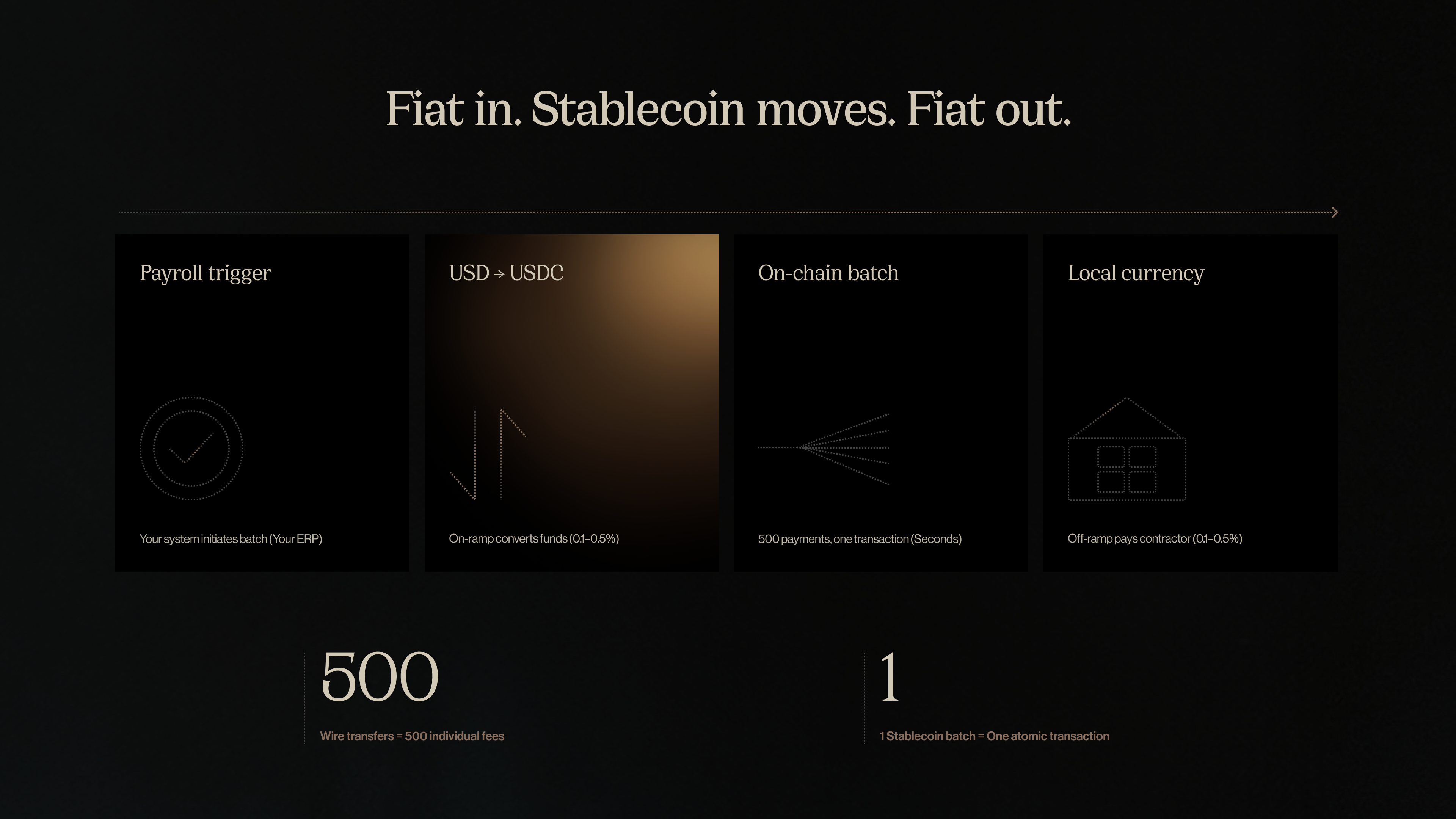
The stablecoin sandwich — fiat in, stablecoin moves, fiat out — applies cleanly to payroll with a few important structural considerations.
At the sending end, your system triggers a payment batch. Your bank or payment provider converts USD to USDC. The batch moves on-chain in seconds, typically settled by the time the payroll processing window closes.
At the receiving end, the contractor's wallet provider (or their bank, if you're working with a bank-integrated solution) converts the USDC back to local currency. In the Philippines, Mexico, Nigeria, and most Latin American corridors, this off-ramp infrastructure now exists with sub-1% conversion costs.
Total cost: on-ramp conversion, blockchain fee (fractions of a cent), off-ramp conversion. Under 1% all-in, compared to 5–15% for traditional international wires.
Batch processing changes the math further
Traditional payroll via wire requires one transaction per contractor — each carrying its own fee. On stablecoin rails, a batch of 500 payments can execute as a single atomic transaction (the entire batch succeeds or fails together), with fees that don't scale per-recipient the way wire fees do. For high-volume payout use cases, this is where the economics become decisive.
The recipient-side complexity: be honest about this
Not every contractor has a wallet or a bank account that accepts stablecoin settlement. This is the piece that payroll vendors and stablecoin enthusiasts sometimes gloss over.
The practical reality: recipient experience varies significantly by corridor and by how you've built your off-ramp. In well-served corridors with mature off-ramp infrastructure — Philippines (GCash, Maya), Mexico (SPEI integration), Latin America broadly — contractors can receive local currency via mobile wallet with minimal friction. In thinner corridors, or where contractors are unbanked, more setup is required.
The honest checklist: first, map your contractor locations against off-ramp coverage. Second, decide whether your payroll provider handles recipient onboarding or whether you do. Third, communicate clearly to contractors what they'll receive and how — a confusing payment experience erodes the cost savings in support tickets.
Who's doing this already
Gig economy platforms, content networks, and marketplace operators are deploying stablecoin payouts at scale across Latin America, Southeast Asia, and Africa — specifically in corridors where traditional wires are most punishing. Enterprise teams are reaching the same conclusion for the same reason: the math is too obvious to ignore.
The math is compelling enough to run the pilot. Start with one corridor, validate the unit economics, and expand from there.
Fin specialises in global payouts on stablecoin rails. See how it works at fin.com →