You're probably not thinking about nostro accounts at all. That's the problem.
Here's a term that most finance and operations leaders outside of FX-heavy teams have never needed to care about: nostro accounts. That's about to change, because they're why your international wires take three days and cost $25–45 per transaction — and why stablecoin rails eliminate that friction in ways that matter for your bottom line.
What a nostro account actually is
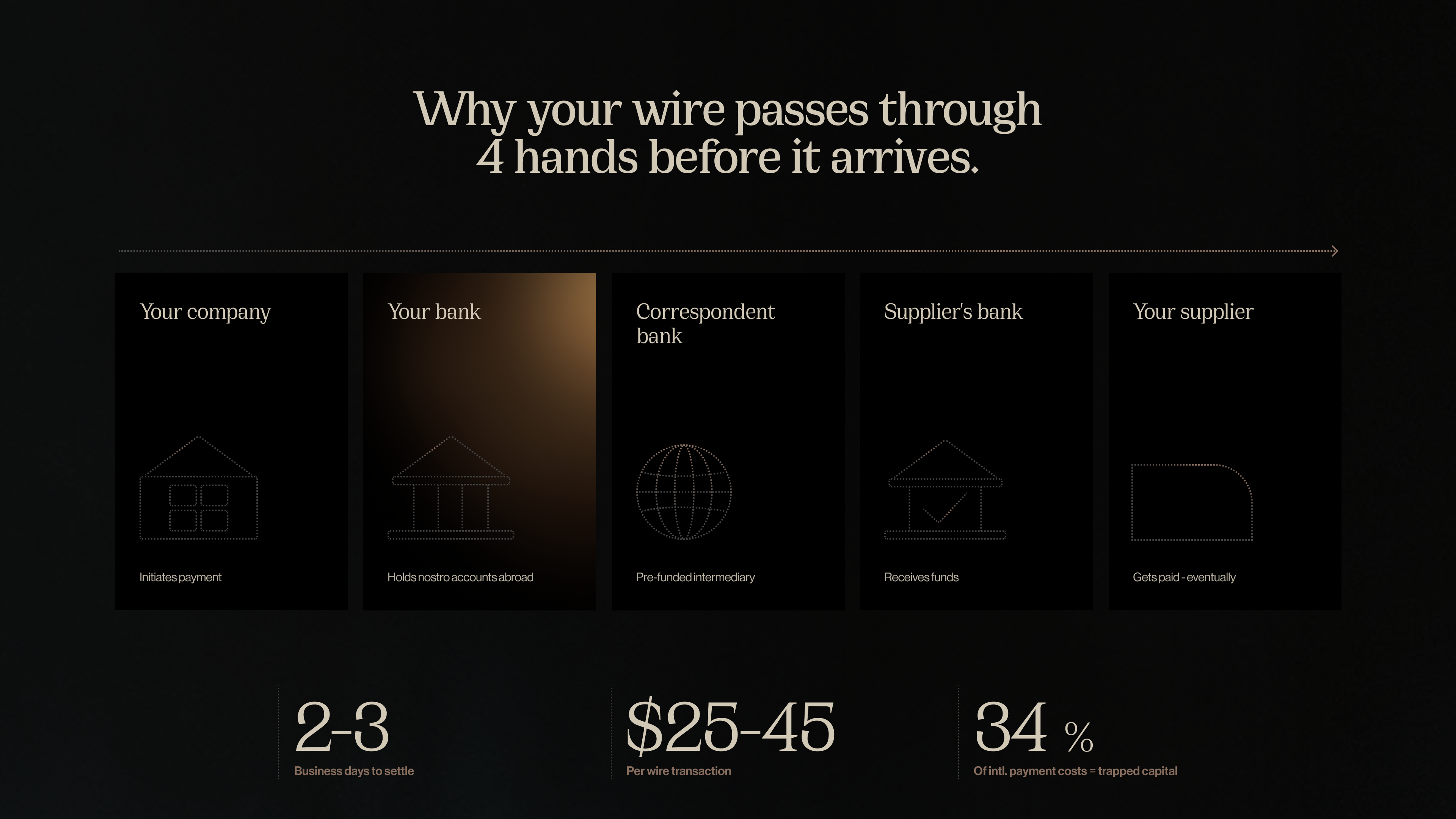
When your U.S. bank needs to send dollars to a supplier in, say, Vietnam, it can't just reach directly into a Vietnamese bank and deposit funds. Instead, it uses a network of correspondent banks — intermediaries with relationships in both countries.
To make this work, your bank pre-funds accounts at correspondent banks in the currencies it needs. These are nostro accounts ("nostro" being Latin for "ours" — the account your bank holds at another bank abroad). The correspondent bank holds a reciprocal account at your bank, a vostro account ("yours").
This system was a brilliant solution for its era. International trade needed a way to settle across borders without requiring every bank to have a direct relationship with every other bank in the world. Correspondent banking networks solved that.
The problem: all that pre-funded capital is sitting idle
For your correspondent bank to pay your Vietnamese supplier immediately when you send a wire, it needs to already have Vietnamese dong or USD equivalent sitting in an account in Vietnam, ready to go. If it doesn't, settlement delays.
McKinsey has estimated that the capital trapped in nostro accounts to pre-fund these payment corridors represents approximately 34% of international payment costs. That's not a fee — that's frozen working capital, sitting in accounts around the world, doing nothing except making settlement possible.
For the global banking system, this adds up to trillions in locked liquidity. For your business, it means you're paying for that locked liquidity through wire fees and the time cost of delayed settlement.
Why international wires are slow: it's not security theater
The 2–3 business day timeline on international wires isn't arbitrary. It reflects the real operational complexity of correspondent chains. Each intermediary bank runs its own compliance checks, reconciles its positions, and processes in batches within its operating hours. Multiple time zones, multiple cut-off windows, multiple compliance queues.
This isn't incompetence. It's the operational reality of a system built for an era before real-time connectivity.
Where stablecoin rails change the math
Stablecoins don't use correspondent banks. There are no nostro accounts. There is no pre-funded liquidity sitting idle in Vietnam.
Instead, the payment moves as a token on a blockchain. The sender's bank converts USD to USDC at an on-ramp, the token moves to the recipient in seconds, and the recipient's bank or payment provider converts back to local currency at an off-ramp. Settlement is final when the transaction is confirmed — typically in seconds to minutes.
The cost structure looks different too. On-ramp conversion (0.1–0.5%), blockchain fees (fractions of a cent), off-ramp conversion (0.1–0.5%). Total under 1%, compared to wire fees plus FX spread plus correspondent margins that can run 3–7% on smaller transactions.
Where stablecoins don't solve the problem yet
Off-ramp coverage is the limiting factor. The stablecoin sandwich only works if there's a reliable off-ramp that can convert USDC to local currency at the destination. Tier-1 corridors — US to Mexico, US to Philippines, US to EU — have solid coverage. Less-traveled corridors may not.
The honest version: stablecoin rails are decisively better than correspondent banking for high-frequency, smaller-value cross-border payments in well-covered corridors. For large, complex, multi-currency settlements in thin markets, correspondent banking still has a role.
Knowing which of your payments falls into which category is the actual optimization exercise here.
Fin moves money across borders on stablecoin rails — faster, cheaper, and without the correspondent chain. See how at fin.com →