PayPal's CEO said stablecoins are most valuable where currencies are weakest. He's right. Here's the corridor-by-corridor reality.
The global stablecoin narrative tends to lead with the U.S. institutional story — banks, broker-dealers, enterprise settlement. That's a real and important story. But the place where stablecoin rails generate the most decisive improvement over legacy infrastructure isn't Goldman Sachs. It's the US–Philippines corridor. And the US–Mexico corridor. And the US–Nigeria corridor.
Why do traditional rails fail hardest in these markets?
Remittances to emerging markets suffer from the full compound pain of correspondent banking: high per-transaction fees, slow settlement times, limited off-ramp options, and FX rates dictated by a small number of intermediaries with pricing power.
The World Bank's data: the global average cost of sending a $200 remittance is 6.5%. Domestic fast-payment systems typically cost under 1%. That 5.5-point gap is the correspondent banking tax — and it falls hardest on the people who can least afford it.
Pre-funding of local-currency accounts (the nostro account problem) represents roughly 34% of international payment costs by McKinsey's estimate. In high-volume corridors like the US–Mexico, established players have enough scale to pre-fund efficiently. In smaller corridors, the economics break entirely — which is why many corridors simply aren't served, or are served only by high-fee operators.
Where stablecoin rails win most decisively
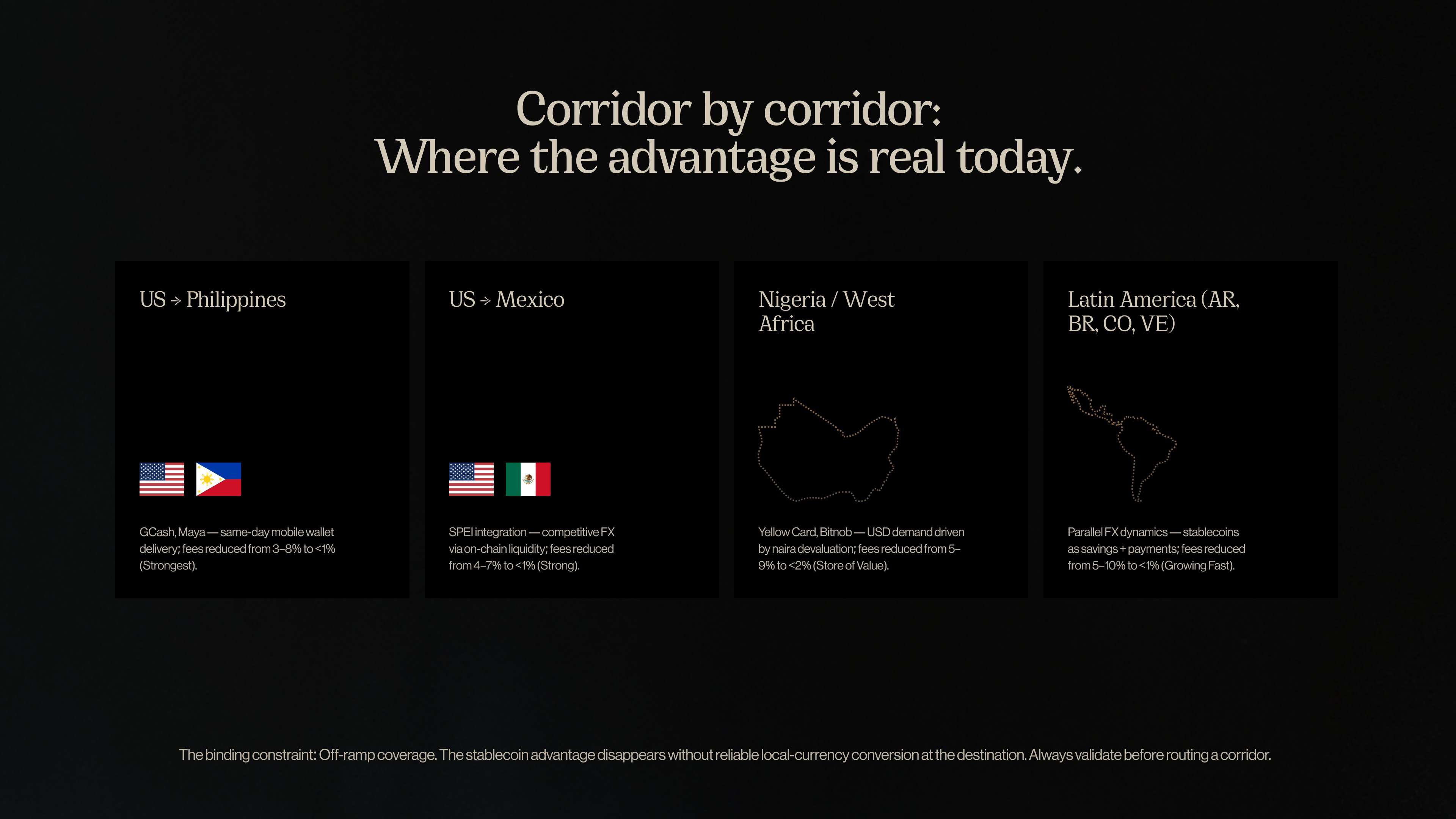
The US–Philippines corridor is the clearest example of stablecoin advantage. There are approximately 3 million Filipinos in the U.S. sending money home. Legacy remittance players charge 3–8% plus FX spread. With stablecoin rails and Philippine off-ramp providers (GCash, Maya) integrated, total costs drop below 1% with same-day delivery. That's not a marginal improvement — it's a structural shift.
The US–Mexico corridor is high-volume and increasingly competitive. Stablecoin rails give smaller operators access to competitive FX rates that were previously exclusive to high-volume correspondent banking players, because on-chain liquidity markets allow multiple providers to compete. DolarApp and others are already demonstrating this.
Nigeria and broader West Africa represent a different dynamic. Demand for USD stablecoins is high because naira devaluation creates structural demand for dollar-denominated stores of value, not just payment instruments. USDC on the ground in Nigeria isn't just a payment tool — it's a hedge. Yellow Card and Bitnob have built off-ramp infrastructure here, and the Central Bank of Nigeria's stance has shifted from hostile to cautiously engaged.
Latin America broadly — Argentina, Brazil, Colombia, Venezuela — shows the same pattern: stablecoins are most valuable where local currency is least stable. Argentina's parallel exchange rate dynamics make dollar stablecoins a practical savings and payments instrument in ways that have no equivalent in the U.S. market.
Where the advantage is limited
Off-ramp coverage is the binding constraint. The stablecoin advantage disappears if there's no reliable local-currency conversion at the destination. Tier-1 corridors have solid infrastructure. Smaller African corridors outside Nigeria, parts of Southeast Asia, and Central Asian markets have thinner coverage.
Low corridor volume also limits the economics. On-ramp and off-ramp providers charge percentage-based fees. At low volumes, the fixed setup costs make stablecoin rails less competitive than legacy wire for occasional, large-value payments.
The practical map for your business
If you're managing cross-border payments to suppliers, contractors, or employees in the Philippines, Mexico, Nigeria, or Latin America, you're operating in corridors where stablecoin rails have measurable, quantifiable cost advantages available today.
If you're moving large, infrequent payments to thin markets through established correspondent relationships — that's where traditional rails still make sense.
The useful exercise: pull your cross-border payment data for the last 12 months. Sort by corridor. Calculate what you spent in wire fees and FX spread. Identify which corridors have stablecoin off-ramp coverage. Run the math. The answer usually makes the decision obvious.
Fin enables fast, low-cost payments across the corridors where it matters most. fin.com →