A USD account for an Indian exporter is, for a company resident in India, an EEFC account at an Indian bank that takes SWIFT wires in the company's name and holds dollars briefly. Wise, Skydo and Payoneer convert receipts to rupees. Fin.com issues named USD accounts that settle as USDC and suit group entities outside India.
If you only read one section
| Question | Short answer |
|---|---|
| What it is | Payment details in your company's legal name that overseas buyers pay in dollars by SWIFT, Fedwire or ACH. |
| What changed in 2026 | From 1 October 2026, export value must be realised and repatriated within nine months, or twelve if invoiced or settled in rupees. |
| What it costs | An EEFC account costs the bank's FX spread and wire charges. Skydo and Wise publish fees. Fin.com pricing is typically 0.01% to 0.3% per transaction, depending on volume and corridor. |
| How long to go live | Fin.com targets a business verification decision in 1 to 5 business days from a complete file, then the banking partner reviews in about 2 to 3 days. |
| The main risk | Fin.com settles dollars as USDC and doesn't pay out in rupees today. A company resident in India must check with its bank and advisers before routing export proceeds this way. |
| How to try it | Email sales@fin.com with your entity's country, your buyers' countries and your monthly volume. |
Table: the short answers for a buying committee. Fin.com docs, RBI and provider pages, 22 November 2026.
Jump to your section: What it is · Routes · The 2026 deadline · Cost · Going live · USDC settlement · Regulation · Integration · Our data · What most guides get wrong · Our take · Comparison · Realisation clock · Fit · FAQ
Key takeaways
- From 1 October 2026 the FEMA (Export and Import of Goods and Services) Regulations 2026 apply, and export value must come home within nine months, or twelve if invoiced or settled in rupees.
- EEFC credits in a calendar month must be converted to rupees by the last day of the next month, after approved uses, under RBI's Master Direction FED MD No. 14/2015-16, para 3.1. That is a separate test from the nine-month deadline.
- Wise says its details for Indian businesses convert every payment to rupees, with a maximum of INR 2.5 million per transaction. Skydo also converts on receipt.
- Fin.com issues named USD virtual accounts only, with no pooled accounts, and its USD SWIFT pay-ins have no maximum limit.
- Fin.com doesn't pay out in rupees today. The live onward path is a USD SWIFT payout to your company's own bank account.
- For a company resident in India, an EEFC account remains the default. Fin.com fits the Indian-founded group with an invoicing entity outside India.
What is a USD account for an Indian exporter? (for the Head of Payments)
A USD account for an Indian exporter is a set of payment details in the company's legal name that overseas buyers pay in dollars. It can be an account at an Indian bank that holds dollars, receiving details from a platform that converts each payment to rupees, or a named account that settles to a dollar stablecoin.
Three terms come up throughout this guide.
EEFC stands for Exchange Earners' Foreign Currency account. It is held at an authorised dealer (AD) bank, meaning an Indian bank licensed to deal in foreign exchange.
SWIFT is the messaging network banks use for cross-border wires. Fedwire is the Federal Reserve's wire system, and ACH is the US batch transfer network. A US buyer might use any of the three.
USDC is a stablecoin, a digital token designed to track the dollar. Fin.com converts USD to USDC at a fixed 1:1 rate.
The name on the account matters. Fin.com issues named USD virtual accounts only, so the buyer's wire is addressed to your company and not to a pool.
Which routes keep the money in dollars? (for the Head of Treasury)
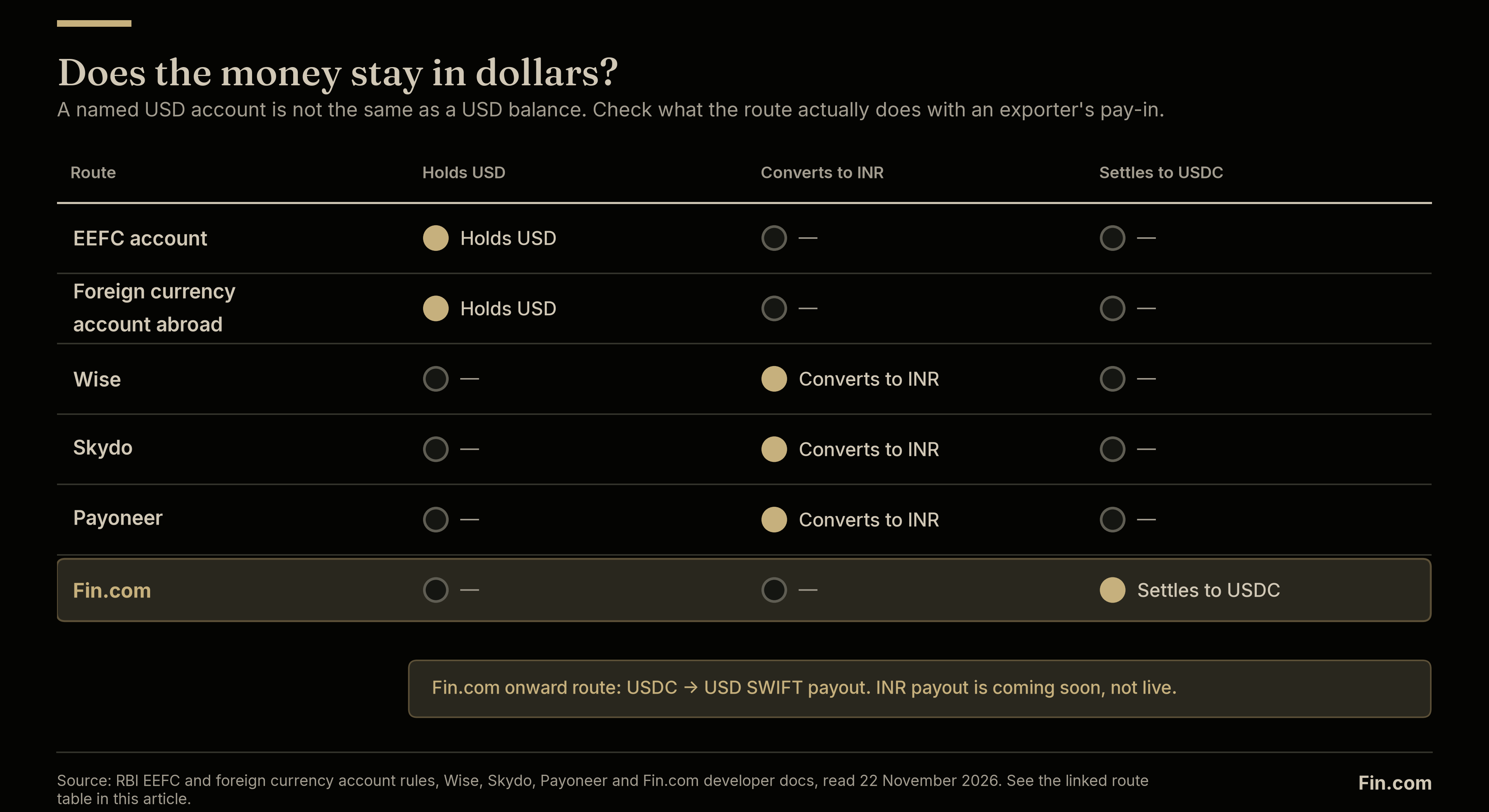
Only two routes hold dollars as dollars: an EEFC account, and a foreign currency account abroad under RBI rules. Wise, Skydo and Payoneer convert to rupees. Fin.com settles each pay-in as USDC to a wallet your company nominates and controls.
| Route | Provider | Holds dollars? | How buyers pay | What reaches you |
|---|---|---|---|---|
| EEFC account | An Indian AD bank | Yes, until the last day of the next month | SWIFT wire | USD at your Indian bank |
| Foreign currency account abroad | A bank outside India | Yes, on RBI's terms | Set by the bank | USD abroad, then repatriated |
| Account details | Wise | No, converted to rupees | Local transfer or SWIFT | INR in your Indian account in 1 to 2 days |
| Virtual USD account | Skydo | No, converted on receipt | Local US transfer such as ACH | INR within 24 hours, per Skydo |
| Receiving account details | Payoneer | Funds can be withdrawn in rupees | Receiving account details | INR to a linked Indian account |
| Named USD account | Fin.com | No, settled as USDC | ACH, Fedwire or SWIFT | USDC in a wallet you control |
Table: six routes and whether the money stays in dollars. RBI, provider pages and Fin.com docs, 21 and 22 November 2026.
We read the terms for a foreign currency account abroad in RBI's earlier Master Direction, which the 2026 regulations supersede. [FIN.COM TO CONFIRM: legal check of the repatriation terms for a foreign currency account abroad against FEMA 23(R)/2026-RB, legal]
How long do you have to bring export dollars home in 2026? (for the CFO)
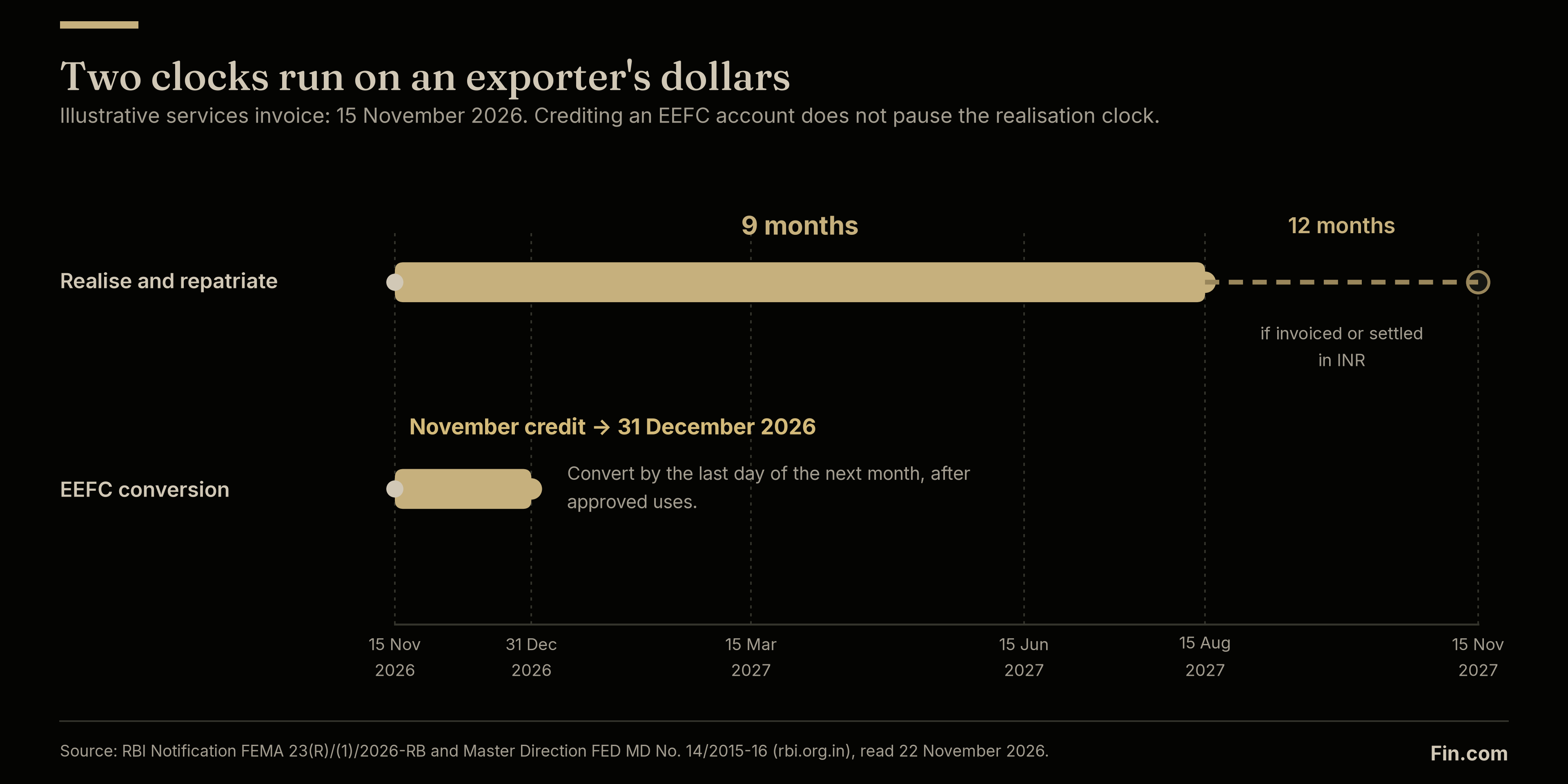
Nine months. From 1 October 2026, the FEMA (Export and Import of Goods and Services) Regulations 2026, as amended by Notification FEMA 23(R)/(1)/2026-RB of 22 September 2026, require export value to be realised and repatriated within nine months.
The clock starts at shipment for goods and at invoice for services. It runs twelve months where the export is invoiced or settled in rupees, and your AD bank may extend it.
A second clock runs alongside it. EEFC credits in a calendar month must be converted to rupees by the last day of the next month, after approved uses. Crediting an EEFC account doesn't pause the first clock, and meeting the first doesn't satisfy the second.
What does each route cost on a $50,000 invoice? (for the CFO)
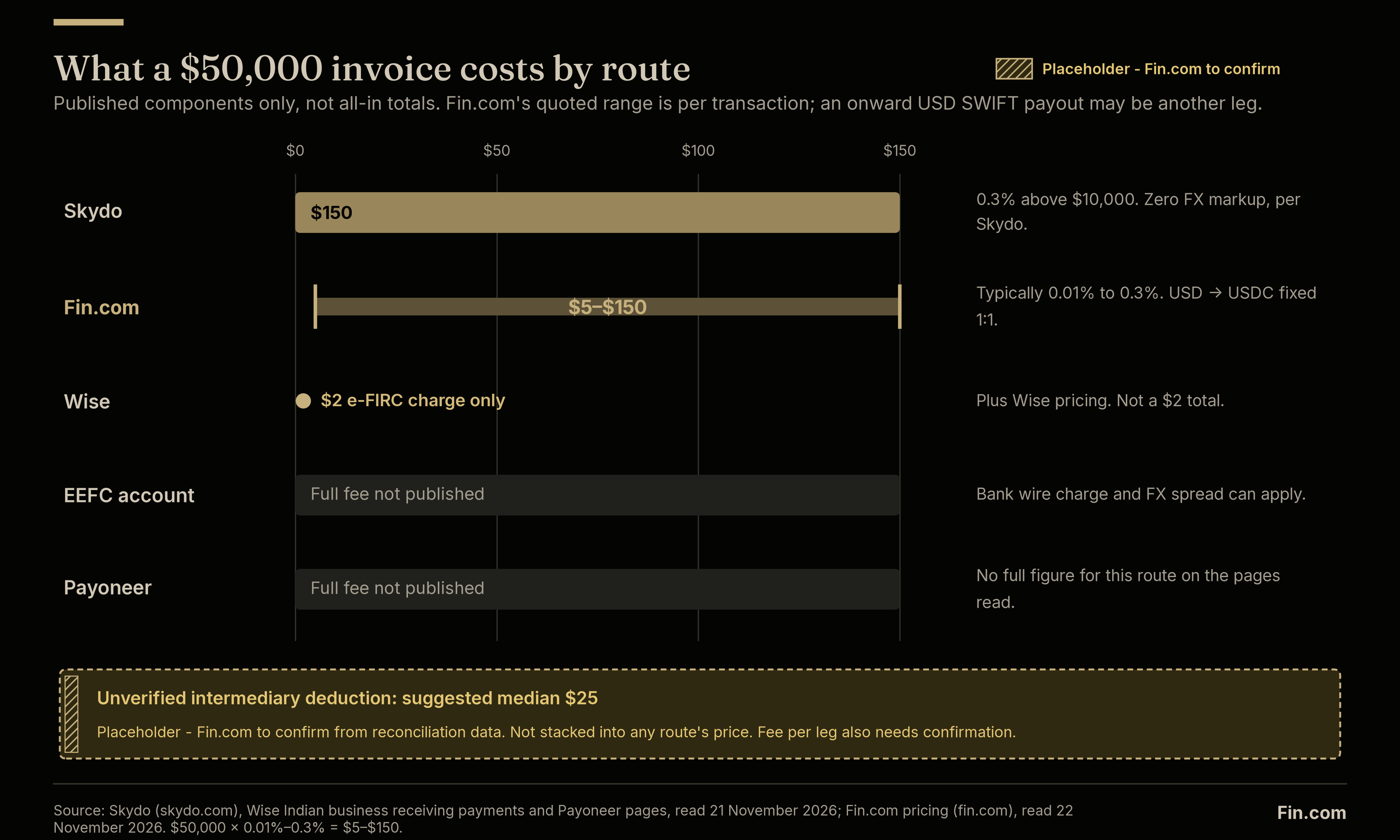
On a $50,000 SWIFT invoice, the published numbers are $150 at Skydo and $5 to $150 per transaction at Fin.com, before intermediary bank fees. Banks, Wise and Payoneer don't publish a full figure for this route on the pages we read.
| Route | Published fee on $50,000 | FX spread | Intermediary fee |
|---|---|---|---|
| EEFC account | Bank wire charges, not published | The bank's, when you convert | Can be deducted in transit |
| Skydo | 0.3% above $10,000, so $150 | Zero FX markup, per Skydo | Not stated |
| Wise | A charge equal to $2 for the e-FIRC, plus Wise pricing | Wise pricing | Not stated |
| Payoneer | No fee given on the page we read | Not stated | Not stated |
| Fin.com | Typically 0.01% to 0.3% per transaction, so $5 to $150 | Not applicable: USD to USDC is fixed 1:1 | See the placeholder below |
Table: line items on a $50,000 SWIFT invoice. Provider pages read 21 November 2026, Fin.com pricing read 22 November 2026.
Two cautions on reading this table.
First, Wise sets a maximum of INR 2.5 million per transaction for Indian businesses, so check a $50,000 invoice against that cap at the day's rate.
Second, the Fin.com route has two legs if the money is going on to a bank: the pay-in, then a USD SWIFT payout. [FIN.COM TO CONFIRM: whether the pay-in and the onward USD SWIFT payout are priced as one transaction or two, and the indicative fee for each on $50,000, pricing team]
How long does it take to go live? (for the Head of Payments)
Going live at Fin.com takes two reviews: Fin.com's own business verification (KYB, or know your business), then a review by its banking partner.
Fin.com's KYB targets from a complete file are 1 business day for low risk, 2 for standard, 4 for high risk and 5 for PEP or sanctions-adjacent cases. Each RFI cycle (a request for more information) adds 1 business day. You have 14 calendar days to answer an RFI, or 7 if it's urgent or high risk.
These are targets, not guarantees.
After Fin.com approves, the USD request goes to the banking partner, whose review of a business typically takes about 2 to 3 days. A bank flag can add up to 24 hours, and Fin.com approval doesn't guarantee bank approval.
Once the account is active, most settlements complete in under an hour. The fiat leg follows the banking calendar and the rail your buyer uses. Swift says nearly 60% of gpi payments are credited within 30 minutes and almost 100% within 24 hours.
For large wires, note two documented allowances. Transactions over $500K may need up to one extra hour, and pay-ins may get risk reviews adding up to two business hours.
What does USDC settlement mean for an Indian exporter? (for the CFO and MLRO)
It means nothing arrives in rupees, and nothing lands at an Indian bank unless you send it there. A buyer's wire to a Fin.com named USD account converts at a fixed 1:1 rate and settles as USDC to the wallet you nominated.
From that wallet you have two live options.
- Hold USDC. Fin.com supports USDC on Ethereum, Polygon, Solana and Base. Stablecoin balances are not covered by deposit insurance or safeguarding schemes.
- Send USD by SWIFT to your company's own bank account. The coverage table marks USD SWIFT payout to India as "Yes", with no maximum transaction limit.
Fin.com doesn't pay out in rupees today. INR local payouts are coming soon and are not a live route.
The USD SWIFT payout doesn't draw on a prefunded balance (prefunding means sending USDC ahead of time to build a balance). Fin.com's funding guide says "USD payouts do not draw on a prefunded balance".
The compliance question we don't answer
RBI's 2026 rules speak of realisation and repatriation. Whether a receipt that settles as a stablecoin, followed by a SWIFT payout, counts for a company resident in India is an open question. We don't give an opinion on it. Ask your AD bank and counsel before you route export proceeds this way.
The tax question
India taxes income from the transfer of a virtual digital asset at 30% under section 115BBH, with no deduction except cost of acquisition and no loss set-off. Section 194S adds 1% tax deducted at source on consideration for a transfer, per CBDT Circular 14 of 2022. Receiving a stablecoin as payment for services is a separate question from transferring it later. Your tax adviser must confirm how both events apply to your company. [FIN.COM TO CONFIRM: legal/tax review of this paragraph]
Who regulates Fin.com, and what does it check? (for the MLRO)
Regulated payment services are provided by FIN.COM Payments Inc., a Money Services Business registered with FINTRAC (registration M23303386) and a payment service provider registered with the Bank of Canada under the Retail Payment Activities Act. Fin.com is not a bank, and it names no Indian licence.
If your policy needs an RBI-authorised provider, choose one that is. Skydo says it holds an RBI licence as a cross-border payment aggregator.
Four points for sign-off:
- Accounts are named, not pooled. Pooling carries a record-keeping risk: the CFPB says that after Synapse's April 2024 bankruptcy, partner banks found a shortfall of between $60 and $90 million between funds held and Synapse's records.
- Nesting is prohibited. Every end customer is onboarded in its own right, so you can't collect for other exporters through your account.
- A sender to receiver relationship is mandatory on every beneficiary, including your own bank account.
- India is classed Not High Risk for USD virtual account residence. That is Fin.com's risk class, not a view on Indian export rules.
What does the integration involve? (for the CTO)
The pay-in side needs little code: once the named account is active, pay-ins settle as USDC to your wallet. The work sits on the payout side, and Fin.com's first payout guide describes it.
- Beneficiary. Create your own bank account as a beneficiary. Each beneficiary gets a system-assigned liquidation address.
- Trigger. With
auto_settlementtrue, the default, sending USDC to that address is the payout trigger. There's no payout endpoint to call. - Control. With
auto_settlementfalse, Fin.com holds the USDC until you call Create a Transfer V2 and then Settle a Transfer V2. Use this to control timing or batch beneficiaries. - Preview. Call Calculate Exchange Rates with the
beneficiary_idto see the cost first. - Webhooks.
beneficiary.liquidation.depositfires when USDC reaches the address and carries the transaction hash.transaction.statusends in COMPLETED or FAILED.
One item is unresolved in the docs. If a payout fails, the payout guide says funds go back to the refund wallet set on the beneficiary, but the same guide also says only PREFUNDED_BALANCE transfers are eligible for refunds. [FIN.COM TO CONFIRM: which refund rule applies to a failed payout, product/docs team]
What Fin.com's coverage table says about India (for the Head of Treasury)
We counted Fin.com's coverage table on 22 November 2026. For India, it shows USD accounts open to India-resident businesses (Not High Risk) and USD SWIFT payouts to India marked "Yes". Rupee payouts aren't live at Fin.com yet.
| What we counted | Result |
|---|---|
| Payout countries listed | 251 |
| USD SWIFT payout marked "Yes" | 230, including India |
| Local-currency payout marked "Yes" | 5, not including India |
| Local-currency payout marked "On-Request" | 48 |
| USD account residence classed Not High Risk | 165, including India and the UAE |
| Classed Enhanced Monitoring, Prohibited, Restricted | 60, 22 and 2 |
| Maximum on USD SWIFT pay-ins | None |
Table: our count of Fin.com's coverage table. Fin.com developer docs, 22 November 2026.
The United States is marked "Not supported" for USD account residence, and US onboarding is coming soon.
First-party figures we're adding before publication:
- [FIN.COM TO CONFIRM: number of India-linked businesses (Indian promoters, entity outside India) onboarded in 2026, suggested "dozens", CRM]
- [FIN.COM TO CONFIRM: median SWIFT pay-in size for these clients, suggested $40,000, transaction data]
- [FIN.COM TO CONFIRM: share of SWIFT pay-ins arriving with intermediary deductions and the median deduction, suggested 30% and $25, reconciliation data]
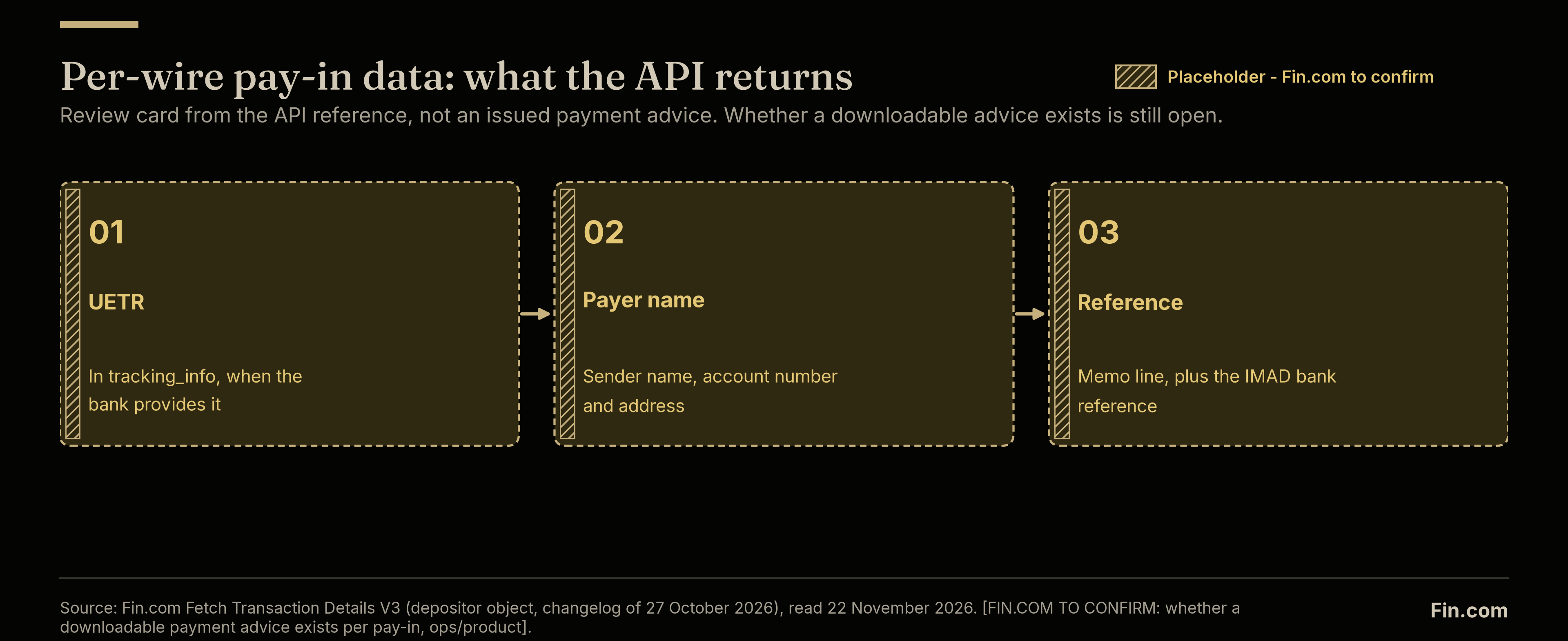
- For each wire, Fin.com's Fetch Transaction Details V3 returns the sender's name, account number, address, memo and the bank reference (IMAD), plus the UETR when the bank provides it. [FIN.COM TO CONFIRM: whether Fin.com also issues a downloadable payment advice per pay-in, ops/product]
What most guides get wrong
"Exporters have 15 months to bring money home." Out of date. From 1 October 2026 the limit is nine months, or twelve if invoiced or settled in rupees. Our own first version of this article cited the older Master Direction, and this version corrects it.
"Crediting EEFC stops the clock." It doesn't. The month-end-plus-one EEFC conversion and the nine-month realisation deadline are separate tests.
"A USD virtual account is the same as an EEFC account." Wise, Skydo and Payoneer details lead to rupees. Only an EEFC account, and a foreign currency account abroad under RBI rules, hold dollars.
"Getting paid in USDC means 30% tax on the whole invoice." Section 115BBH taxes income from the transfer of a virtual digital asset. Receipt for services is a separate question, and an adviser must confirm both. [FIN.COM TO CONFIRM: legal/tax review of this paragraph]
"Any USD account in the company's name counts as export realisation." That is open for anything that settles as a stablecoin. RBI's rules talk about realisation and repatriation, and the exporter should check with its AD bank.
"Fin.com pays rupees." Not today. The live path is a USD SWIFT payout to the exporter's own bank account.
"Fin.com is a bank, or holds an Indian licence." Neither. Regulated services are provided by FIN.COM Payments Inc. in Canada, and no Indian licence is named.
Our take
For a company resident in India, an EEFC account is still the default home for export dollars. Anyone who tells you a stablecoin account replaces it hasn't read the 2026 rules.
Those rules shortened the window and kept the language of realisation and repatriation. A route that adds an open compliance question to a nine-month clock is a poor trade for a resident exporter whose bank already offers an EEFC account.
Where Fin.com fits is the Indian-founded group with an entity outside India that needs USD SWIFT details in its own name, fast, with no cap on wire size. That entity isn't the Indian exporter of record, it often already runs a dollar treasury, and a named account with a 1 to 5 business day KYB target solves a real problem for it.
We'd rather lose the resident exporter to its AD bank than win it with an answer that doesn't survive a FEMA review.
How do the providers compare? (for the buying committee)
Three of the five convert to rupees on arrival. An Indian bank's EEFC account holds dollars in India. Fin.com is the only one of the five that settles to a stablecoin.
| Provider | What you receive | Published price | Limit per payment | Best for | Drawback |
|---|---|---|---|---|---|
| Indian bank EEFC account | USD, held until the end of the next month | Bank FX spread and wire charges | Set by the bank | Resident exporters that pay suppliers in dollars | Opening timelines vary by bank |
| Wise Business | INR in 1 to 2 days, with an e-FIRC | A charge equal to $2 per transfer for the e-FIRC, plus Wise pricing | INR 2.5 million maximum, $5 minimum | Small and mid-size invoices | Can't hold or send from the details. SWIFT takes 2 to 6 working days |
| Skydo | INR within 24 hours, per Skydo | $19 up to $2,000, $29 to $10,000, 0.3% above | Not stated | Flat fees and a free FIRA | No dollar holding |
| Payoneer | INR withdrawn to a linked Indian account | No fee for this route on the page we read | Not stated | Freelancers and marketplace sellers | Pricing not on the page we read |
| Fin.com | USDC in a wallet you control | Typically 0.01% to 0.3% per transaction | No maximum on USD SWIFT pay-ins | Group entities outside India receiving large wires | No rupee payout today, no Indian licence named |
Table: five providers on receipt, price and limits. Provider pages read 21 November 2026, RBI and Fin.com read 22 November 2026.
Bridge and Conduit also issue USD accounts in a customer's name that settle to stablecoins. Conduit says it does this without a US legal entity. Check India eligibility with each.
The export realisation clock: a calculator for your deadline (for the Head of Treasury)
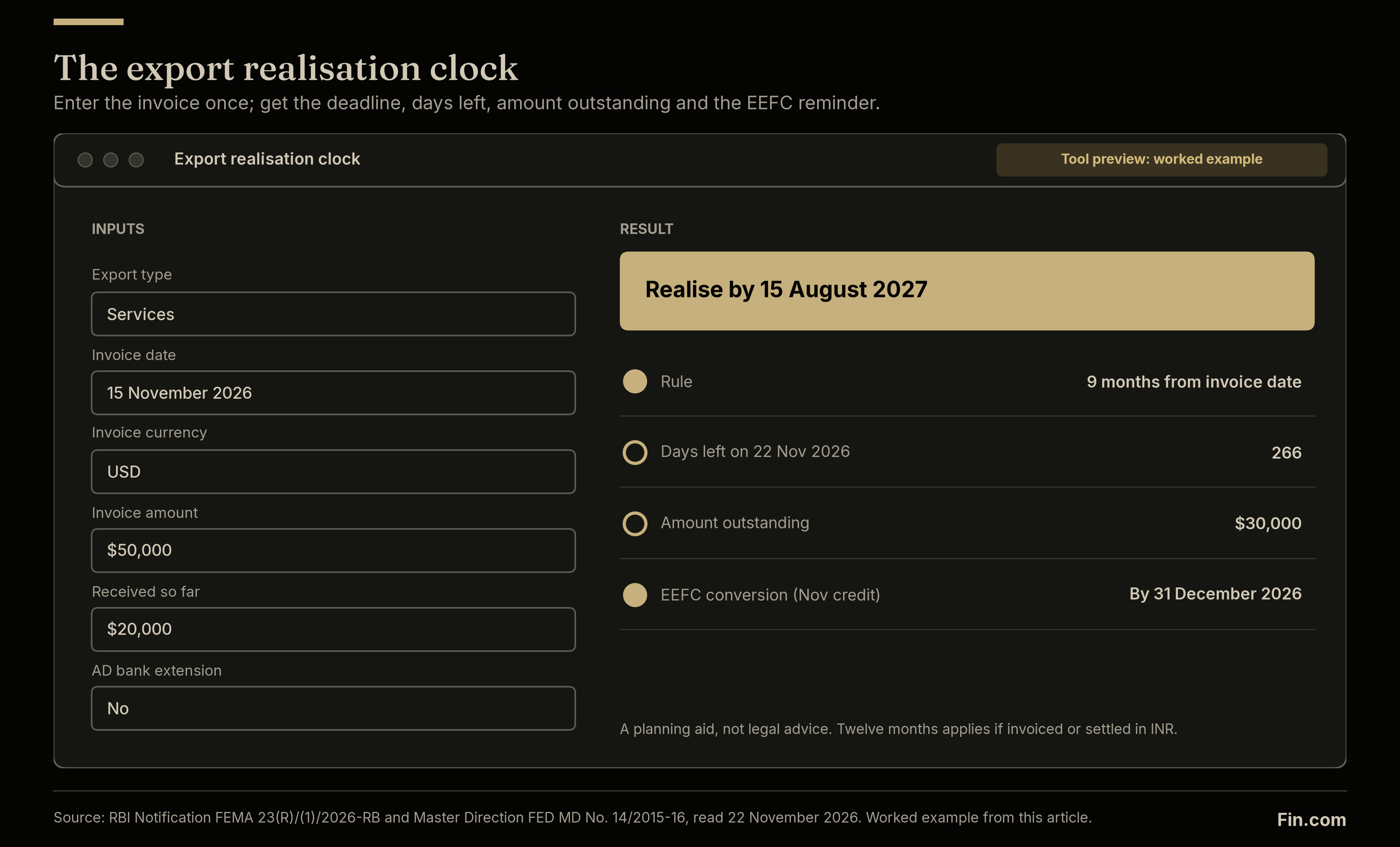
The export realisation clock tells you the date by which an invoice must be realised and how much is still outstanding. We're building it for this page, and the logic is simple enough to run by hand.
Inputs:
- Export type: goods or services
- Shipment date (goods) or invoice date (services)
- Invoice currency: USD or INR
- Amount received so far
- AD bank extension: yes or no
The logic follows the RBI notification. Start from the shipment date for goods or the invoice date for services. Add nine months, or twelve if the invoice is in rupees or settled in rupees. If your AD bank has granted an extension, use the date it gave you.
The output is the deadline, the days left, the amount outstanding, and a reminder that any EEFC credit must be converted by the end of the next month.
A worked example: a services invoice for $50,000, dated 15 November 2026, in USD, with $20,000 received and no extension. The deadline is 15 August 2027. On 22 November 2026 that leaves 266 days and $30,000 outstanding. If the $20,000 reached an EEFC account in November, it converts by 31 December 2026.
The calculator is a planning aid, not legal advice.
Which option fits your situation?
The right route depends on where the receiving entity sits and whether you need dollars or rupees at the end.
| Your situation | Best fit | Why |
|---|---|---|
| Resident exporter that pays suppliers in dollars | EEFC account | It holds dollars inside RBI's rules until the end of the next month |
| Resident exporter that wants rupees fast | Skydo or Wise | Both convert on receipt and issue a FIRA or e-FIRC |
| Freelancer or marketplace seller | Payoneer | It suits sellers already paid through marketplaces |
| Indian group with an invoicing entity outside India, such as the UAE | Fin.com | The UAE is Not High Risk for USD accounts, and SWIFT pay-ins have no maximum |
| Company that wants dollar receipts as USDC | Fin.com, after advice | Pay-ins settle 1:1 as USDC to a wallet you control |
| US-registered entity | A provider that onboards US entities | The United States is "Not supported" at Fin.com, and US onboarding is coming soon |
Table: route by situation. RBI, provider pages and Fin.com docs, 22 November 2026.
Who it's for and who it isn't for
Fin.com is for companies that receive large dollar wires and want USD payment details in their own legal name, with each pay-in settled as USDC. For an Indian group, that most often means an entity outside India.
It isn't for:
- Exporters resident in India that need rupees at an Indian bank as the default outcome. Fin.com doesn't pay out in rupees today.
- Teams whose policy needs an RBI-authorised provider.
- Flows that must stay fiat to fiat. Every Fin.com flow has a stablecoin on one side.
- Cash businesses. Fin.com doesn't support cash pay-in or pay-out.
- US-registered entities, which can't onboard today.
Getting started
Tell us where your invoicing entity is registered, who pays you and how much arrives each month. We'll tell you whether a named USD account fits and what the onward path looks like for your flows.
Talk to our team at sales@fin.com.
How we researched this
We read the RBI notification, the RBI Master Direction, the Income Tax Act section and the Swift gpi page on 22 November 2026. We read the Wise, Skydo and Payoneer pages on 21 November 2026 and recorded only what they state.
For Fin.com, we pulled the developer docs on 21 November 2026 and rechecked them on 22 November 2026. We counted the coverage table row by row: 251 payout countries, the USD SWIFT and local-currency marks for each, and the USD account risk class for each country of residence.
Where a Fin.com number isn't public, we've marked it for confirmation and not estimated it.
Frequently asked questions
Can an Indian company hold a USD account in its own name?
Yes, through an EEFC account at an Indian AD bank. Each month's credits must be converted to rupees by the last day of the next month, after approved uses.
How long does an Indian exporter have to realise export proceeds in 2026?
Nine months from 1 October 2026. The clock runs from shipment for goods and from invoice for services, and it is twelve months where invoiced or settled in rupees. Your AD bank may extend it.
When must EEFC balances be converted to rupees?
Do Wise or Skydo let an Indian exporter hold dollars?
No. Wise says its details for Indian businesses can't hold or send money and convert every payment to rupees. Skydo converts on receipt too.
Payoneer or Wise for an Indian exporter?
Wise is the easier one to plan around, because it publishes its limits. Wise lists an INR 2.5 million maximum, a charge equal to $2 per transfer for the e-FIRC, and 2 to 6 working days for SWIFT. Payoneer suits sellers already paid through marketplaces.
Does receiving USD into a virtual account give me a FIRA or e-FIRC?
It depends on the provider. Wise issues an e-FIRC and Skydo a FIRA for their own routes. Fin.com's API returns the payer's details, memo, IMAD and, when available, the UETR for each wire (Fetch Transaction Details V3). [FIN.COM TO CONFIRM: whether Fin.com issues a downloadable advice or statement per pay-in, ops/product]
Can a Fin.com named USD account receive SWIFT wires for an Indian company?
Yes, the docs allow it. India is Not High Risk for USD accounts. Each pay-in settles as USDC, so a company resident in India should check with its AD bank and adviser first.
Can a Fin.com named USD account receive from a US client by ACH or Fedwire?
Yes. Fin.com USD virtual accounts take ACH, Fedwire and SWIFT pay-ins. The Fedwire customer transfer cut-off is 6:45 PM ET.
Is there a limit on SWIFT pay-ins?
No. Fin.com's coverage page says USD SWIFT pay-ins have no maximum limit.
Does Fin.com pay out in INR?
No, not today. INR local payouts are coming soon and aren't live. The live path is a USD SWIFT payout to your company's own bank account.
After we go live, how do we move funds to India?
How long does Fin.com take to approve an Indian company?
The target is 1 to 5 business days from a complete file, depending on risk. The banking partner then reviews in about 2 to 3 days, and each RFI cycle adds 1 business day.
Is receiving USDC taxed at 30% in India?
Not necessarily on receipt, and your adviser must confirm. Section 115BBH applies 30% to income from the transfer of a virtual digital asset, with 1% TDS under section 194S. Receipt for services is a separate question. [FIN.COM TO CONFIRM: legal/tax review of this paragraph]
Can an Indian company receive USDC legally?
That is an open question, and we don't give an opinion on it. RBI's rules speak of realisation and repatriation, so check with your AD bank and counsel.
Who is the account for if not an India-resident exporter?
It's for Indian groups' entities outside India, for example in the UAE or Singapore, that receive USD. The UAE is classed Not High Risk. Check your entity's country in the coverage table.
Is Fin.com a bank?
No. Regulated services are provided by FIN.COM Payments Inc., registered with FINTRAC and the Bank of Canada. Stablecoin balances are not covered by deposit insurance.
Sources
- Reserve Bank of India, Notification FEMA 23(R)/(1)/2026-RB: https://www.rbi.org.in/Scripts/BS_FemaNotifications.aspx?Id=13714, read 22 November 2026
- Reserve Bank of India, Master Direction FED MD No. 14/2015-16, para 3.1: https://www.rbi.org.in/Scripts/BS_ViewMasterDirections.aspx, read 22 November 2026 [FIN.COM TO CONFIRM: deep link to para 3.1; candidate https://www.rbi.org.in/Scripts/BS_ViewMasDirections.aspx?id=10198 needs a legal check]
- Income Tax Department, section 115BBH: https://www.incometaxindia.gov.in/w/section-115bbh, read 22 November 2026
- Swift gpi: https://www.swift.com/products/swift-gpi, read 22 November 2026
- Federal Reserve, Fedwire Funds Service operating hours: https://www.frbservices.org/resources/financial-services/wires/fedwire-funds-service-national-settlement-service-operating-hours/, read 22 November 2026
- CFPB, Synapse Financial Technologies: https://www.consumerfinance.gov/enforcement/actions/synapse-financial-technologies-inc/, read 22 November 2026
- Fin.com developer docs, coverage and capabilities: https://developer.fin.com/guides/coverage/coverage-and-capabilities, read 22 November 2026
- Fin.com developer docs, supported rails and currencies: https://developer.fin.com/guides/coverage/supported-rails-and-currencies, read 21 November 2026
- Fin.com developer docs, funding your balance: https://developer.fin.com/guides/move-money/funding-your-balance, read 21 November 2026
- Fin.com developer docs, processing windows and cut-offs: https://developer.fin.com/guides/operations/processing-windows-and-cutoffs, read 21 November 2026
- Fin.com developer docs, SLA for compliance: https://developer.fin.com/guides/customers-and-compliance/sla-for-compliance, read 21 November 2026
- Fin.com developer docs, how USD features work for a customer: https://developer.fin.com/guides/move-money/how-usd-features-work-for-a-customer, read 21 November 2026
- Fin.com developer docs, nested payments and onboarding: https://developer.fin.com/guides/customers-and-compliance/nested-payments-and-onboarding, read 21 November 2026
- Fin.com developer docs, sender and receiver relationships: https://developer.fin.com/guides/beneficiaries/sender-and-receiver-relationships, read 21 November 2026
- Fin.com developer docs, sending your first payout: https://developer.fin.com/guides/beneficiaries/sending-your-first-payout, read 21 November 2026
- Fin.com: https://www.fin.com/, read 22 November 2026
- Fin.com, named USD SWIFT accounts: https://www.fin.com/products/named-usd-swift, read 22 November 2026
- Fin.com, licences: https://legal.fin.com/licenses, read 22 November 2026
- Wise, receiving payments for Indian businesses: https://wise.com/help/articles/71lNXW0Ls3gEFhUH8PtodV/receiving-payments-for-indian-businesses, read 21 November 2026
- Skydo: https://www.skydo.com/, read 21 November 2026
- Payoneer: https://www.payoneer.com/, read 21 November 2026
- Bridge: https://www.bridge.xyz/, read 21 November 2026
- Conduit: https://conduit.financial/, read 21 November 2026
About the author
[FIN.COM TO CONFIRM: two-line bio and LinkedIn URL]