Mesh is a crypto infrastructure platform that powers embedded crypto experiences — connecting users to major exchanges including Coinbase, Kraken, and Binance. When a fintech or financial platform wants to let their users buy, sell, transfer, or hold crypto without building direct exchange relationships from scratch, Mesh is the layer that makes it seamless. They handle the exchange connectivity. Their clients build the product on top.
That positioning creates a specific set of infrastructure demands. Mesh's clients aren't moving small amounts occasionally. They're serving users across multiple exchanges, multiple assets, and multiple jurisdictions — and they need the underlying settlement to be fast, reliable, and broad across assets.
Where Fin fits
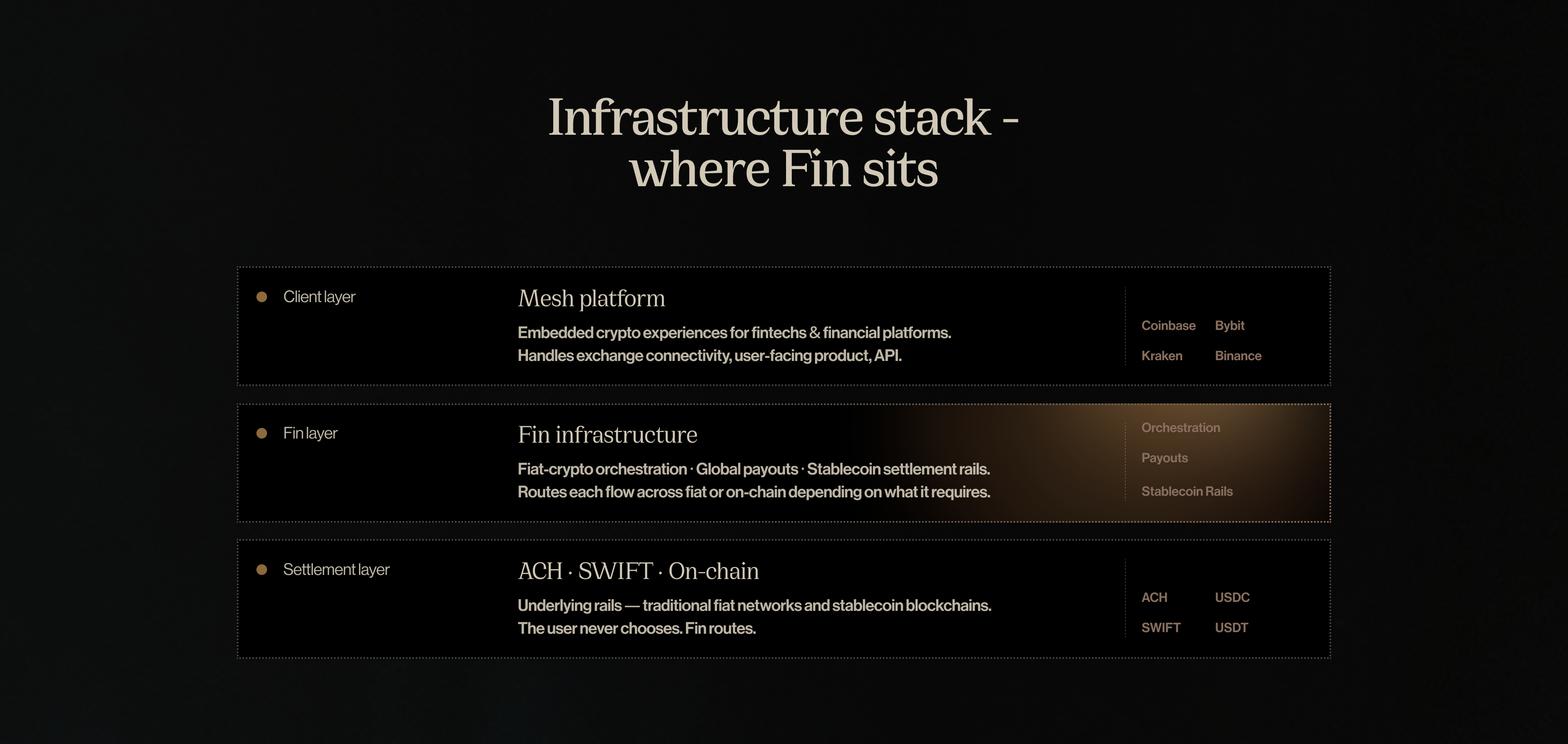
Fin's role in the Mesh stack covers three connected layers: fiat-crypto orchestration, global payouts, and stablecoin settlement rails.
Fiat-crypto orchestration handles the conversion and routing logic between traditional fiat flows and crypto settlement. When a user deposits dollars and needs the right crypto asset at the right price through the right exchange, Fin's orchestration layer handles that routing — so Mesh doesn't have to build and maintain that logic independently for every asset and exchange pair they support.
Global payouts handle the outbound side. When Mesh's clients need to move value out — withdrawals, settlements, distributions — Fin's infrastructure handles last-mile delivery across geographies and currencies.
Stablecoin settlement rails handle the growing share of flows where USDC and other stablecoins are the most efficient settlement path. Fin provides the rails that make that settlement work at the speed and reliability that Mesh's institutional and high-volume clients require.
What's live and what's being built
USDC is already operational across Mesh's platform. BTC, ETH, USDT on Tron, PYUSD, and PIUSD are in active development — expanding the asset coverage to match the breadth that sophisticated clients demand. Exchange integrations with Bybit and Kraken are in progress, extending the reach of Mesh's connectivity layer and the volume capacity behind it.
Settlement latency is a continuous focus. In high-frequency environments, Mesh serves clients where transaction speed is a product differentiator; shaving seconds off settlement time is engineering work that directly affects customer experience.
The infrastructure logic
What makes the Mesh partnership instructive is that it illustrates where stablecoin rails and traditional fiat infrastructure work best together rather than in competition. A user depositing dollars into a crypto platform doesn't think about whether their settlement moves via ACH, SWIFT, or on-chain. They think about whether it was fast and whether it worked. Fin's job is to make sure it was both — routing intelligently across fiat and stablecoin rails depending on what each flow requires.