Wire fees are visible. They show up on your bank statement: $25 outbound, $15 incoming, maybe $45 for international. You can see them. You can report them. You can argue about them with your bank.
What's much harder to see — and usually larger — is the working capital cost of settlement delay. The capital that sits immobile for 48–72 hours because you sent a wire on Friday, or because a holiday weekend created a gap in your settlement window.
The structure of the problem
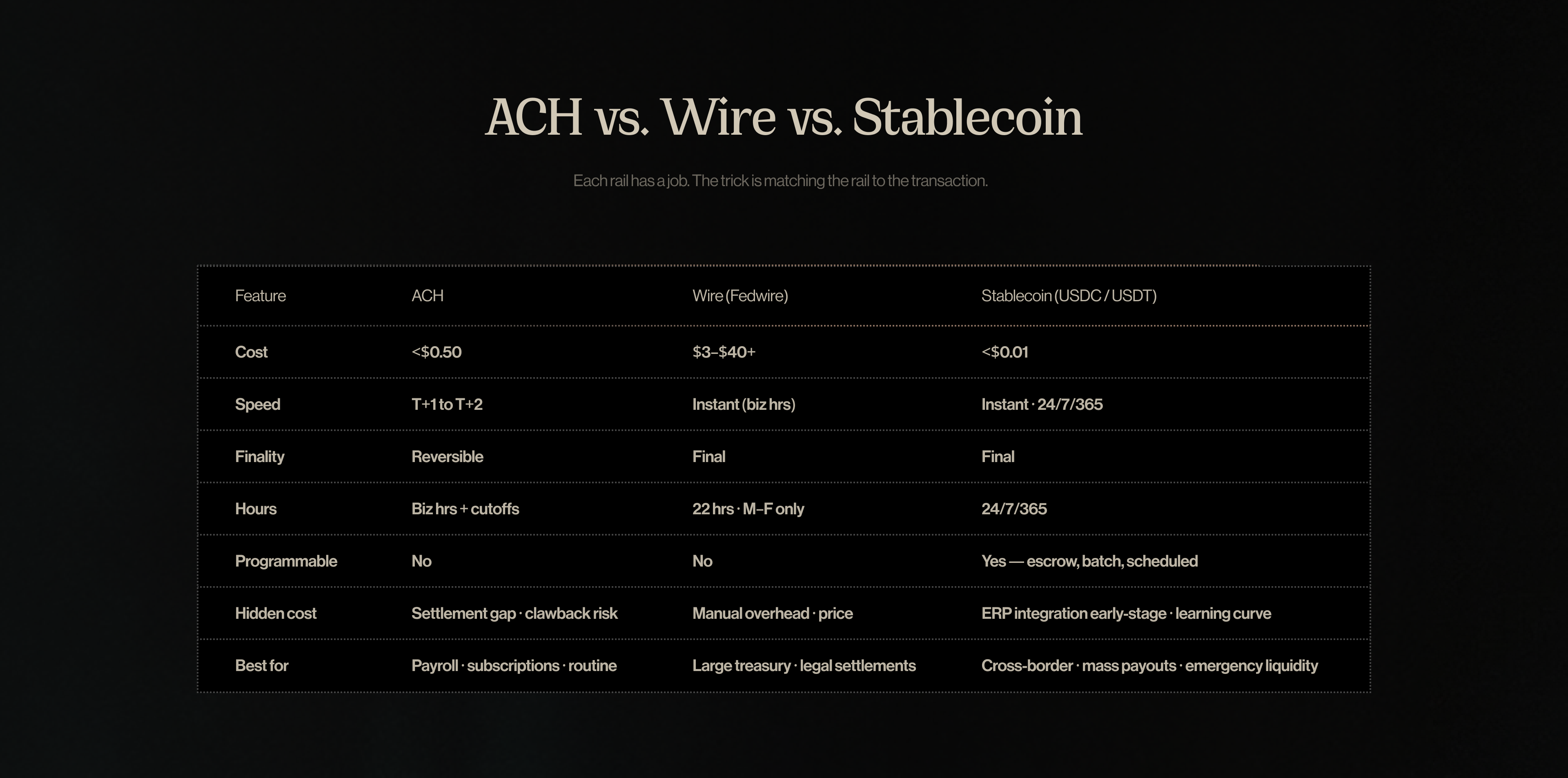
Fedwire operates 22 hours a day, Monday through Friday. It is closed on federal holidays. International wires through correspondent banking networks are subject to each intermediary's operating hours, cut-off times, and holiday schedules.
This means: any payment initiated late Friday won't settle until Monday morning at the earliest — Tuesday morning if Friday happens to precede a U.S. holiday. Any payment crossing time zones into a country observing a different holiday schedule adds additional delay.
For teams managing cross-border supplier payments, this creates predictable, repeated working capital gaps. You've released the obligation. The counterparty hasn't received funds. And you're holding a receivable that won't resolve until the banking system reopens.
The actual cost: run your own numbers
Take your average daily outbound wire volume. Estimate what percentage gets trapped over weekends and holidays — a reasonable estimate for companies with global supply chains is 20–30% of monthly wire volume initiated Thursday–Friday. Apply your weighted average cost of capital to that trapped amount for the 48–72 hour delay window.
For a company sending $10 million per month in international wires, with $2.5 million (25%) initiated late-week, and a 5% annualized cost of capital: $2.5M × (5% ÷ 365) × 2.5 days = approximately $10,000 per year just from weekend settlement gaps.
Modest at $10 million. Scale to $100 million in monthly wires and you're at $100,000 per year in hidden working capital cost from settlement timing alone — before you account for public holidays, operational cost of exceptions, and payments that fall into settlement limbo over long weekends.
What 24/7 settlement actually changes
Stablecoin rails settle 24 hours a day, 7 days a week, 365 days a year. Blockchain doesn't observe Thanksgiving. It doesn't have a Fedwire cutoff at 6pm EST. There are no correspondent banks in different time zones with their own operating schedules.
A Friday evening stablecoin payment settles Friday evening. A payment initiated on Christmas Day settles on Christmas Day.
For leadership teams, this means the working capital calculation changes. Buffer capital held against settlement timing uncertainty can be reduced. Cash flow forecasting becomes more precise. The team dealing with a Friday emergency liquidity need doesn't have to choose between an expensive same-day wire and waiting until Monday.
The specific use cases where this matters most
Emergency supplier payments — Friday afternoon urgent requests that currently require expensive same-day Fedwire processing are the highest-value immediate use case. The optionality of 24/7 settlement has real value even for companies that mostly pay on schedule.
Cross-border payroll with contractors in time-zone-distant markets. Paying a contractor in Southeast Asia on Thursday gets the funds there before their weekend rather than after.
Intraday liquidity management for finance functions that need to move capital between entities across time zones — this is the institutional use case that doesn't make consumer press but is genuinely meaningful for large operations.
The wire fee is the visible cost. The settlement gap is the invisible one. Most leadership teams have never modelled the second number. Run it for your operation — the math usually makes a more compelling internal case than any stablecoin industry report.
Fin settles payments 24/7 — no cutoffs, no correspondent delays, no Monday morning surprises. fin.com →